
Kitchen Knife Buying Guide: Three Knives Beat a Fifteen-Piece Block
Which knives you actually need, what hardness and edge angle mean in use, and why sharpening matters more than the purchase.
Knife blocks are the most reliably wasteful purchase in a kitchen. A fifteen-piece set at $200 contains three knives you will use, a pair of scissors, a sharpening rod most people use incorrectly, and eight items whose function is to fill slots in a wooden block. The same $200 buys three excellent knives and a stone, and produces a kitchen where every knife is sharp.
This guide covers which knives you actually need, what steel hardness and grind angle mean for how a knife behaves, and the maintenance that matters far more than the purchase — because a $200 knife left blunt cuts worse than a $30 knife sharpened last week.
The quick answer
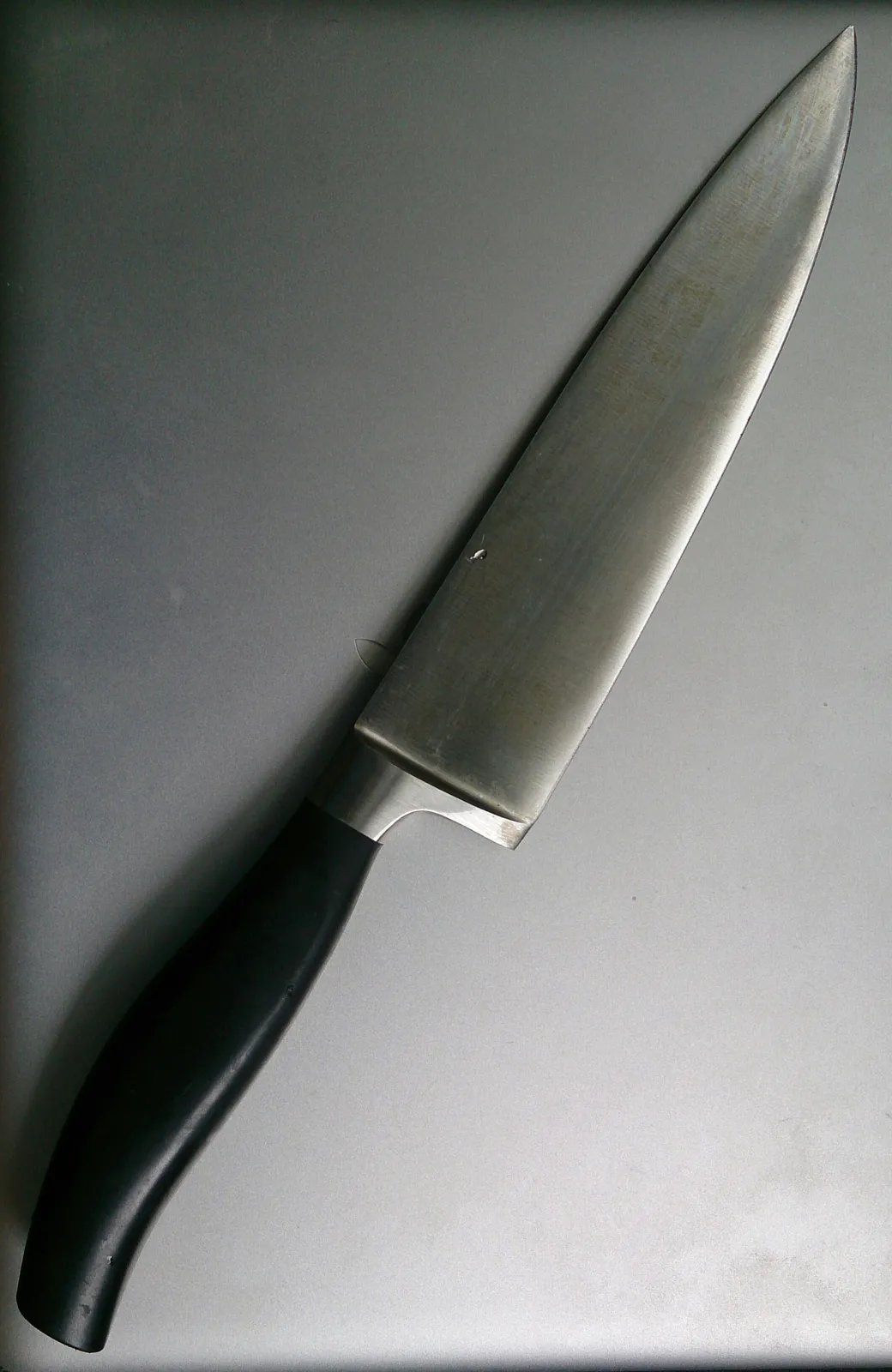
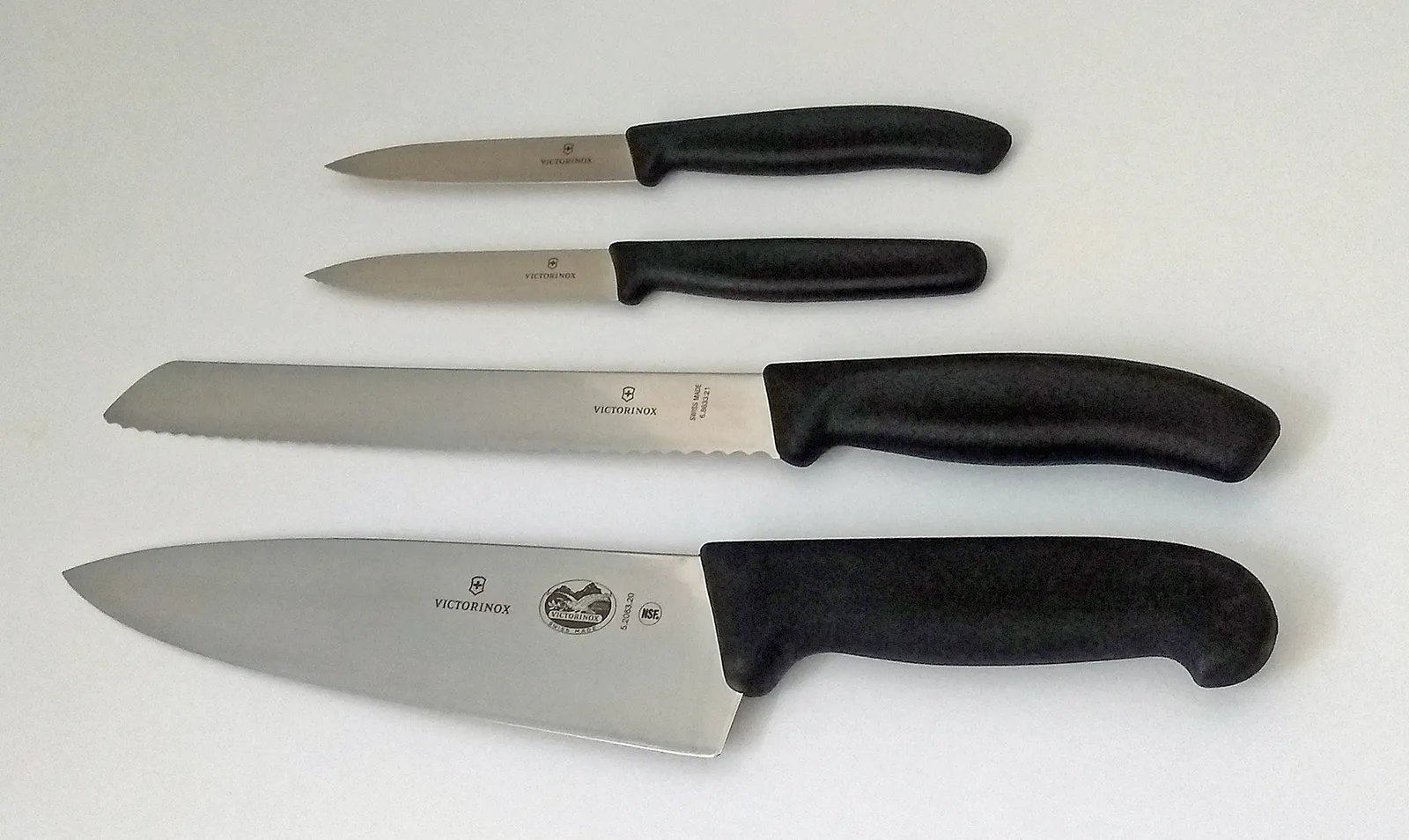
Buy three knives: a 20cm chef's knife for most work, a 9cm paring knife for small precise jobs, and a serrated bread knife because a straight edge cannot saw crust without crushing the loaf. That covers virtually all home cooking. Budget $80-$200 for all three.
Then buy a whetstone or a guided sharpener, roughly $30-$50, and learn to use it. This is not optional equipment; it is the difference between owning knives and owning knife-shaped objects.
Skip the block set, skip the santoku unless you have handled one and prefer it, and skip the knife with the highest steel-hardness number if you are not prepared to sharpen with diamond stones.
Buy a wooden or plastic cutting board. Glass, stone, and ceramic boards destroy an edge in a few strokes, and they are the most common cause of a new knife feeling blunt within a month.
The three knives, and why the rest are optional
The chef's knife does 80-90% of the work: chopping, slicing, dicing, mincing, and breaking down most vegetables and boneless meat. Length is the main decision. 20cm is the standard and handles most tasks with margin; 15cm feels controllable to people nervous of large blades and runs out of length on a cabbage; 25cm is a professional length that many home boards cannot accommodate.
The paring knife handles what the chef's knife cannot: peeling, hulling strawberries, deveining, and anything done in the hand rather than on the board. It is cheap and it is used constantly.
The bread knife is a specialist tool with no substitute. Serrations concentrate force at points, which lets the blade initiate a cut through hard crust without compressing the crumb. It also handles tomatoes and citrus better than most people expect.
Worth adding later, if a specific need appears: a boning knife if you butcher whole chickens regularly, a slicer if you carve roasts, and a nakiri if you prep large volumes of vegetables and like a flat profile. Each solves a real problem for someone; none belongs in a first purchase.
Japanese versus German, which is really a geometry question
The distinction sold as a national style is mostly about hardness and edge angle, and those two travel together for good physical reasons.
German-style knives typically use softer steel around 56-58 HRC, ground to roughly 20 degrees per side. The softer steel rolls rather than chips when it hits something hard, so the edge can be straightened with a honing rod and the knife tolerates rougher use. The wider angle is more durable and less keen.
Japanese-style knives typically run harder, 60-63 HRC, at 10-15 degrees per side. That produces a genuinely sharper edge that glides through produce, and a brittle one: hitting a bone or twisting in a squash can chip it, and chips need grinding out rather than honing back.
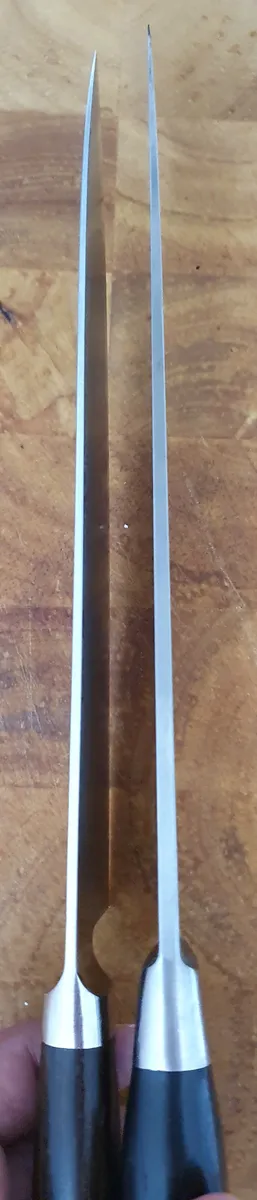
The honest recommendation: German-style for a first good knife, or for anyone who shares a kitchen with people who will put it in a dishwasher or scrape it across a board sideways. Japanese-style once you have a sharpening habit and control over how the knife is treated. Blade profile follows the same split — German knives have more belly for rocking, Japanese knives are flatter for push-cutting, and which feels natural depends on how you already cut.
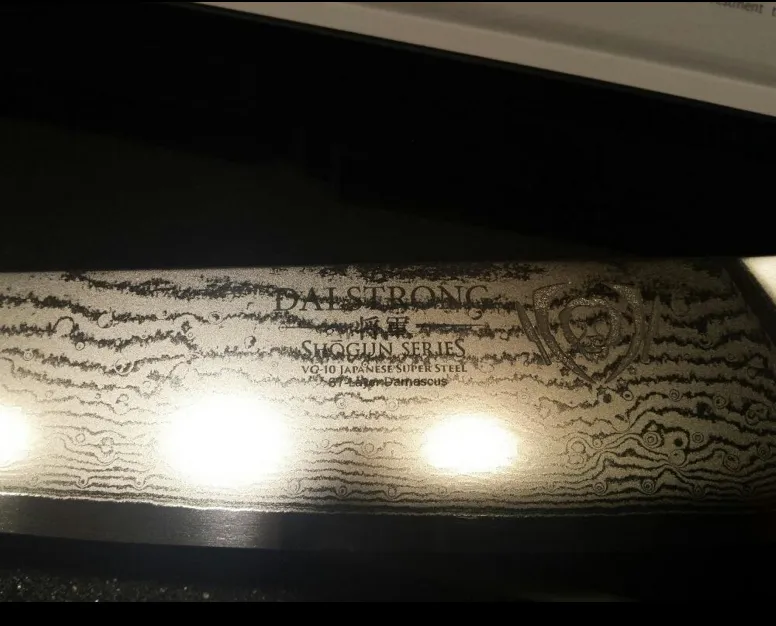
Laminated and Damascus-patterned blades combine a hard core with softer outer layers, which gives some of the edge-holding of hard steel with more toughness. The visible pattern is cosmetic; the construction underneath is the real feature.
Construction details that are worth checking
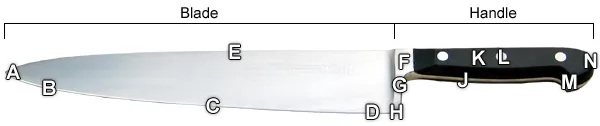
Full tang means the steel runs the length of the handle, which gives balance and strength. Partial tangs and rat-tail tangs are cheaper and are where handles come loose after a few years.
Forged versus stamped is less decisive than it used to be. Forged blades are made from a heated billet and are typically thicker with a bolster; stamped blades are cut from sheet and are lighter and thinner. Good stamped knives are excellent, particularly Japanese ones, and the distinction says more about weight preference than quality.
Handle material affects grip when wet more than durability. Textured polymer grips reliably; polished wood becomes slippery with oil; full-metal handles look excellent and are the worst of the three with wet hands. Try holding the knife with a pinch grip on the blade if you can — the shape where blade meets handle is what determines comfort over an hour of prep.
Weight is a preference with no correct answer. Heavier knives do more of the work through momentum; lighter knives are faster and more precise. Both camps are populated by good cooks, and this is the specification most worth testing in person.
Sharpening: the part that actually matters
Two distinct operations get confused. Honing realigns an edge that has rolled over microscopically, using a smooth steel or ceramic rod. It removes almost no metal and should be done every few uses. Sharpening removes metal to form a new edge, using stones or a guided system, and is needed every few months for home use.
A honing rod cannot fix a blunt knife, and that misunderstanding is why so many people believe their knives are dull despite "sharpening" them weekly.
For sharpening, a two-sided whetstone around 1000 and 3000 grit costs $30-$45 and does everything a home cook needs. The technique is learnable in an afternoon: consistent angle, light pressure, alternating sides, finishing with a few very light passes. Guided systems that clamp the blade at a fixed angle cost more and remove the skill requirement, which for many households is the right trade.
Avoid pull-through sharpeners with fixed carbide blades. They work by scraping metal away aggressively at whatever angle the slot dictates, and they will make a knife cut in the short term while removing far more steel than necessary and destroying the original geometry. They shorten a knife's life considerably.
There is a reliable test for sharpness: a sharp knife slices through a sheet of paper cleanly with no snagging. A knife that tears the paper needs sharpening, not honing.
Storage, boards, and the things that blunt knives
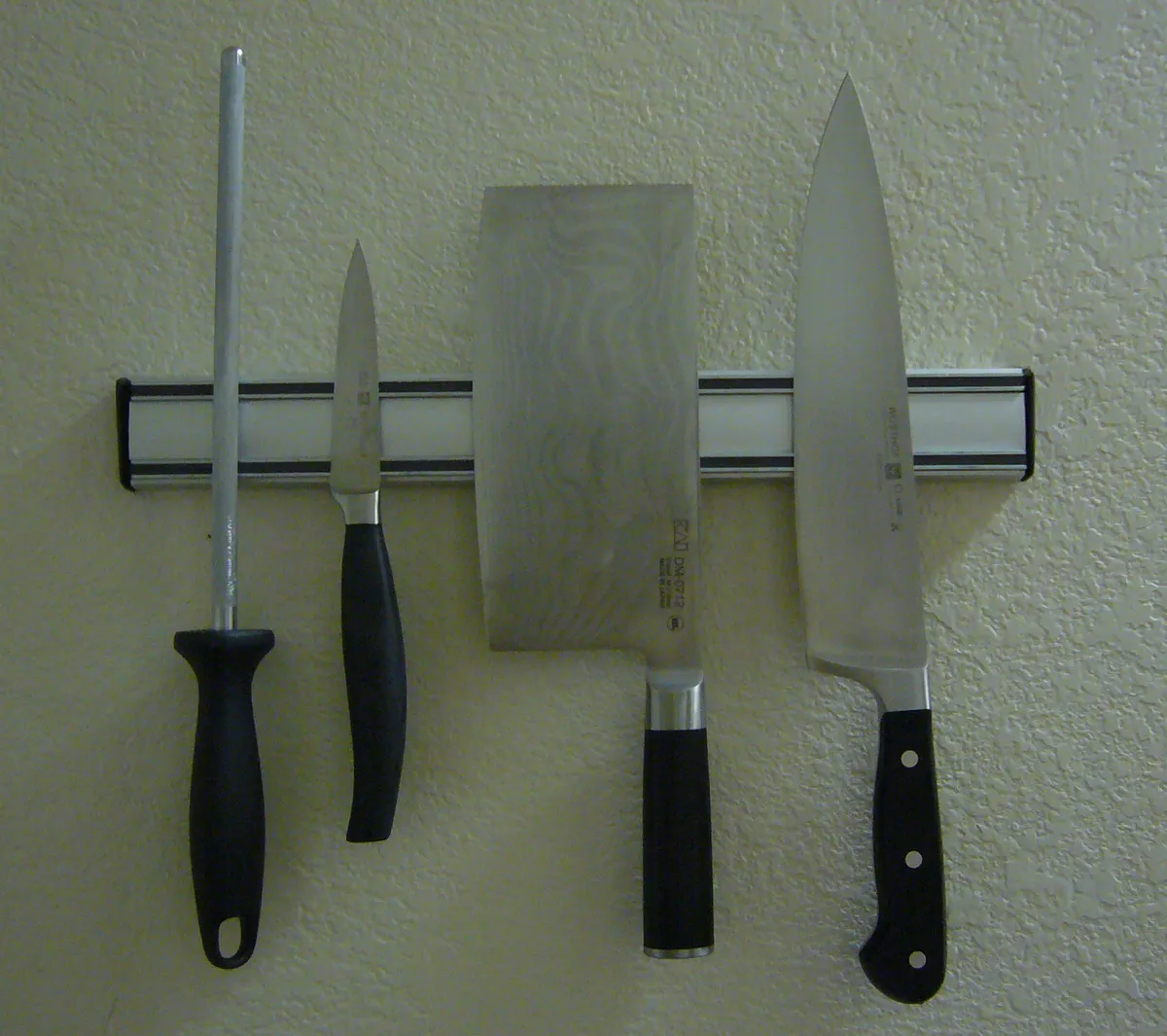
A loose drawer is the fastest way to dull and chip edges, because blades knock against everything. A magnetic rack, an in-drawer knife tray, or a block all solve it; magnetic racks are cheapest and let you see what you are reaching for.
Never put a good knife in a dishwasher. Detergent is abrasive and alkaline, the heat can damage handle adhesives, and blades knock against other items. Hand-wash and dry immediately — even stainless steel will spot if left wet, and high-carbon steel will rust within hours.
The board matters as much as the storage. End-grain wood is gentlest on edges, edge-grain wood is nearly as good and cheaper, and soft plastic is fine and dishwasher-safe. Bamboo is harder than most wood and slightly more abrasive. Glass and stone are edge-destroying and should be used for serving, not cutting.
Steel types, briefly
Knife steel names look impenetrable and reduce to a trade between three properties, the same trade that applies to pocket knives. Edge retention, corrosion resistance, and toughness cannot all be maximised, and a kitchen knife's ideal balance differs from a camping knife's.
High-carbon non-stainless steels take a very keen edge and are easy to sharpen, and they rust visibly within hours if left wet. They also develop a grey-blue patina with use, which is protective and alarms people who have not seen it before.
Stainless steels contain enough chromium to resist corrosion. Softer stainless around 56-58 HRC is easy to maintain and needs more frequent sharpening. Harder powder-metallurgy stainless steels hold an edge for a long time and need diamond or ceramic stones to sharpen, since standard whetstones struggle above about 61 HRC.
For a home kitchen, a mid-hardness stainless is the right answer for almost everyone: it survives the occasional wet drainer, sharpens on a $35 stone, and holds an edge for weeks. Choosing an exotic steel and then sharpening it badly produces a worse knife than choosing a modest one and sharpening it well.
Where price stops buying performance
Under about $25, a chef's knife will generally have soft steel that needs sharpening weekly and a handle that may loosen. There are honourable exceptions — some inexpensive stamped knives with moulded grips are genuinely good and used in professional kitchens for exactly that reason.
The $40-$120 band is where the value is. In it you can get properly heat-treated steel, a comfortable handle, and a blade that holds an edge for weeks of home use.
Above roughly $250, you are buying materials, hand-finishing, and craftsmanship. These are real and they are aesthetic and tactile rather than functional; a $600 knife does not cut an onion better than a well-sharpened $90 one. It may be a more pleasing object to use, which is a legitimate reason to buy it as long as it is the stated reason.
The unglamorous summary: three knives, a stone, and a wooden board, for roughly $150 total, outperforms any block set at any price — and the sharpening habit matters more than every other decision on this page combined. If you want the same reasoning applied to the appliances that sit next to them, our multicooker vs air fryer vs slow cooker guide takes the same approach to countertop machines, and our Instant Pot Duo Plus review works through which of its many functions get used.
More coupon shopping advice

Home Security Camera Buying Guide: Local vs. Cloud Storage
A practical, balanced buying guide to home security cameras that weighs local storage against cloud subscriptions, wired versus battery power, camera placement, night vision, smart detection accuracy, and smart home integration.

Beginner Mirrorless Camera Buying Guide
A practical, honest walkthrough of what actually matters when buying your first mirrorless camera, from sensor size and lens mounts to autofocus, video specs, and the real total cost of a beginner-friendly system.

Air Purifier Buying Guide: CADR, ACH, and Filter Costs Explained
A practical walkthrough of the numbers that actually matter when buying an air purifier — CADR and ACH for sizing, true HEPA versus marketing terms, real three-year filter costs, realistic noise levels, and when a purifier won't help at all.