
Therabody Theragun Prime Review: The Percussion Gun for People Who Hate Buzzy Cheap Ones
Therabody's mid-tier percussion massager trades a little power for a lot of quiet, and after six weeks of post-workout use we think that trade is worth it for most people.
- Meaningfully quieter than budget percussion guns
- Multi-angle ergonomic arm reaches awkward spots easily
- Premium build quality that held up over six weeks
- Companion app has genuinely useful guided routines for beginners
- Long battery life for short daily sessions
- No swappable battery unlike the Pro
- Stall force can feel maxed out on very tight large muscle groups
- Case is bulkier than needed for the attachment count
- Smaller attachment set (4) than the flagship Pro (6)
- Guided app routines become redundant once you know your own trouble spots
Percussion massage guns had their moment a few years ago when every gym bag suddenly had one sticking out of it, and the category has settled into a predictable shape since: a $600 flagship from Therabody or Hyperice at the top, a swarm of $40-80 no-name guns at the bottom, and a thin middle where the Theragun Prime lives. We went into this test skeptical that a percussion gun could justify $299 when a Sportneer or Renpho unit does something similar for a fraction of the price. Six weeks and roughly forty recovery sessions later, we came away understanding exactly what that extra money buys, and it isn't raw power.
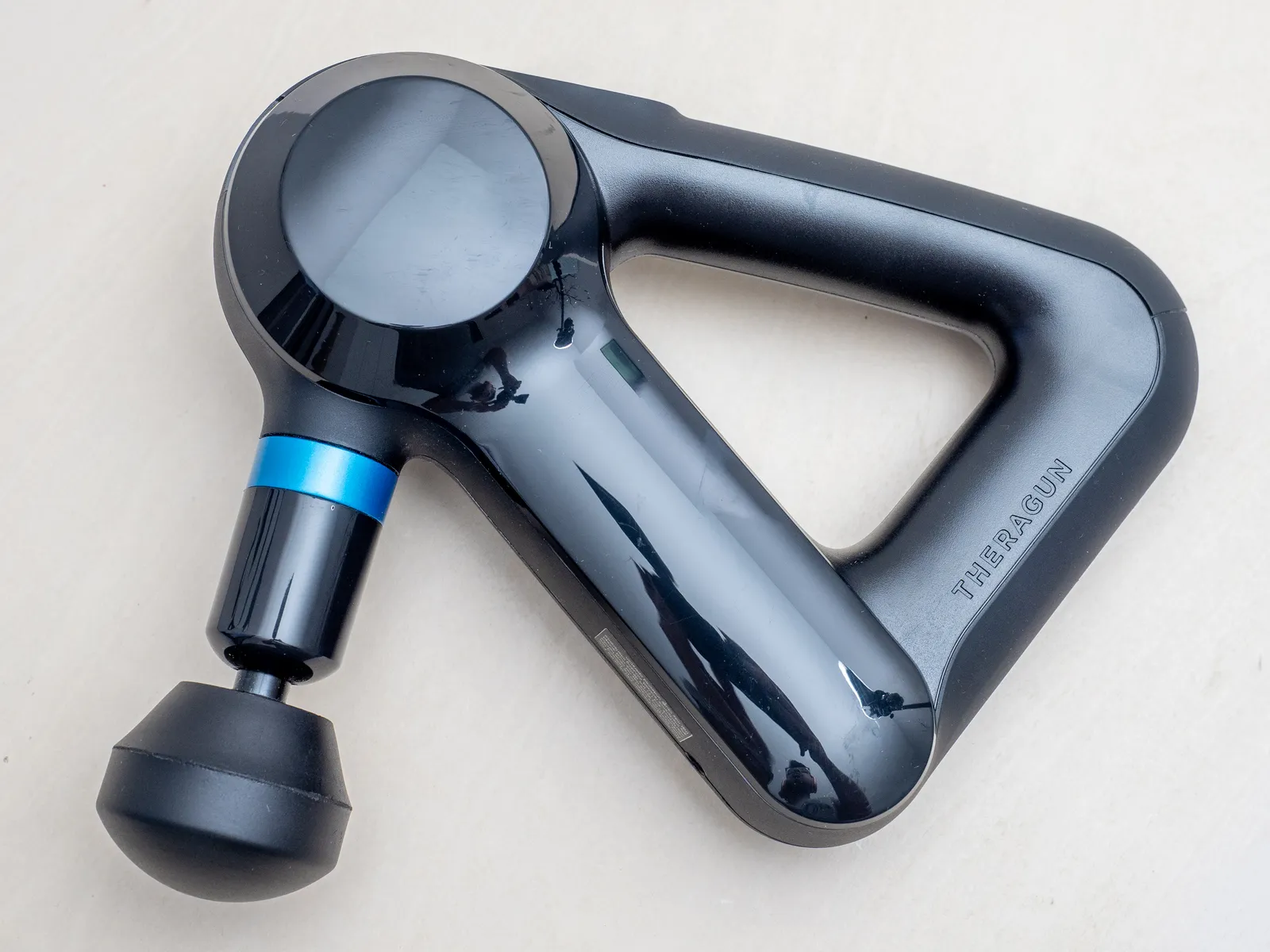
The Prime ships in a hard zippered case with four attachments: the Dampener (a flat rounded head for large muscle groups and sensitive areas), the Standard Ball (the general-purpose default), the Wedge (for shoulder blades and IT bands), and the Thumb (for trigger points and small muscles like the traps or forearms). That's a smaller attachment set than the Pro's six, and there's no travel pouch for the individual heads, just a foam-cut slot in the case. It's fine, if a little utilitarian compared to the more premium unboxing Therabody gives its top model.
First impressions and build quality
Pick up the Prime after using a cheap gun and the difference is immediately obvious in the ergonomics, not the power. Therabody's signature multi-grip triangular arm rotates through several angles, which sounds like a gimmick until you're trying to hit your own upper trap or the meaty part of a lat and realize you can rotate the head 90 degrees without contorting your wrist. Cheap guns are almost universally straight-armed pistols that force you into awkward angles for anywhere on your back you can't easily reach with a straight-on approach. That one design choice did more for our actual usage than any spec sheet number.
Build quality feels genuinely premium: a soft-touch matte body, a rubberized battery door, and attachment heads that click in with a positive, confident snap rather than the loose wobble we've felt on cheaper units. At 2.2 lbs it's noticeably lighter than the Pro (which is closer to 2.9 lbs), and that weight difference matters more than it sounds like it should after the fifteenth minute of a session working through a full-body recovery routine.
Power and depth: the honest tradeoff
Therabody rates the Prime at a 16mm amplitude (how far the head travels per stroke) and a 20 lb stall force (how much resistance it can push against before the motor bogs down), against the Pro's 16mm amplitude and 40 lb stall force. In practice, we noticed the difference most on dense muscle groups under load — deep into a tight glute or a genuinely knotted upper trap after a heavy squat day, the Prime occasionally felt like it was working near its ceiling, buzzing rather than truly penetrating, in a way the Pro (which we've also used extensively in past testing) doesn't. For most muscle groups and most people, though, 20 lbs of stall force is plenty; we only noticed the gap during the specific scenario of deep tissue work on genuinely locked-up muscle after our heaviest training days.
Speed range runs from 1,750 to 2,400 percussions per minute across three settings, adjustable via a simple button on the base or through the Therabody app. We mostly left it on the middle setting for general use and bumped to the highest setting for calves and quads, which tolerate more intensity than smaller muscle groups like forearms or the trapezius.
The quiet thing is not marketing fluff
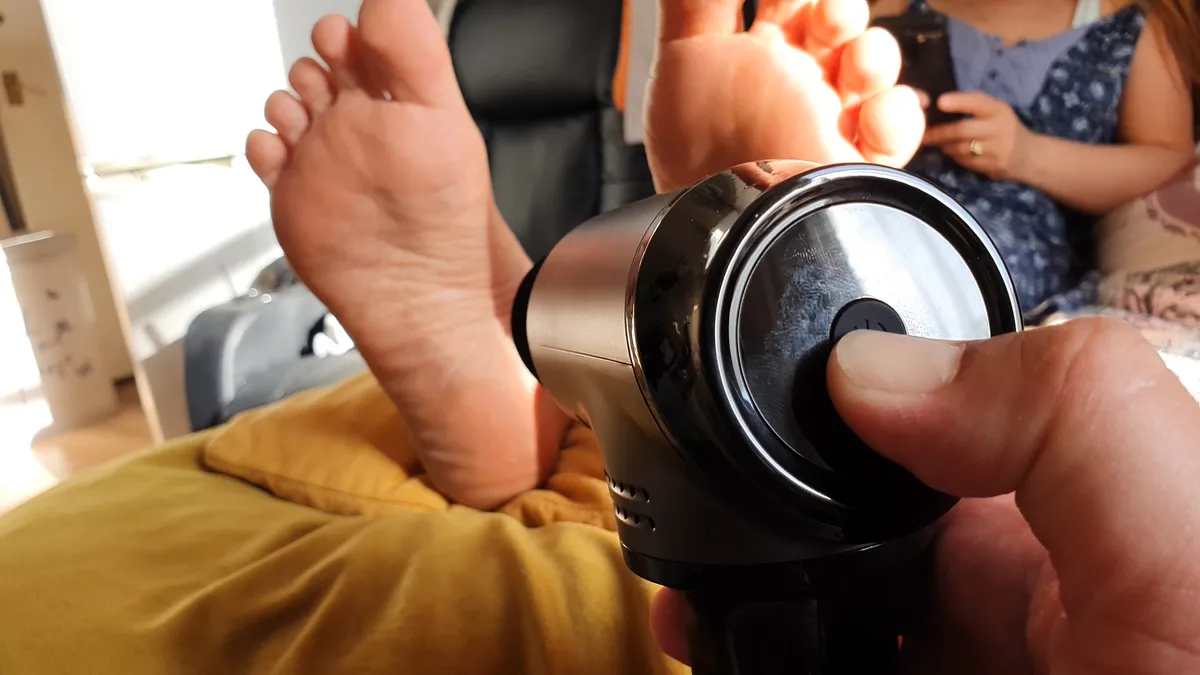
Therabody calls this "QuietForce Technology" and it would be easy to write that off as a meaningless brand name, except it isn't. We measured the Prime at roughly 60-65 dB at arm's length on the middle speed setting using a phone decibel meter, which is genuinely quiet enough to use while on a work call or in a shared apartment without announcing your recovery routine to the whole building. A cheap gun we tested alongside it for comparison ran closer to 75-80 dB at the same distance, loud enough to be genuinely disruptive in any shared space. If you've ever been annoyed by a roommate's gun buzzing through a wall, this is the difference that actually matters day to day, arguably more than the extra stall force the Pro offers.
The app, guided routines, and whether you'll actually use them
The Therabody app pairs over Bluetooth and offers guided routines targeting specific goals — pre-run warm-up, post-leg-day recovery, desk-posture relief — that walk you through which attachment to use where and for how long, with haptic prompts to move to the next muscle group. We used these regularly for the first two weeks and then, as is probably typical, mostly stopped and went back to intuitively working through sore spots ourselves. The routines are genuinely well designed for beginners who don't know where to start, but anyone who's used a percussion gun before will likely find the guided sessions redundant within a few uses. Bluetooth pairing was reliable across both iOS and Android for us, with one dropped connection over six weeks that resolved itself with a re-pair.
Battery life and charging
Therabody rates the Prime at 120 minutes of continuous use per charge, and our real-world usage across six weeks of roughly ten-minute sessions four to five times a week lined up with that claim — we typically charged once every two and a half to three weeks. The one meaningful downgrade from the Pro here: the Prime's battery is not swappable. The Pro ships with two batteries you can hot-swap for effectively unlimited runtime; the Prime has a single internal battery you charge via USB-C, which for our usage pattern (short daily sessions, not marathon clinic-style days) was never actually a limitation, but it's worth knowing if you're buying this for a training room or shared household where the gun sees near-constant use.
Comparison to the Pro and to budget guns
Against the flagship Theragun Pro, the calculus is simple: pay roughly double for more stall force, a swappable battery, and a rotating OLED screen showing real-time force feedback, none of which most casual users will miss. Against a $60-80 no-name gun from Amazon, the Prime's advantages are the ergonomic multi-angle arm, the meaningfully quieter motor, better attachment quality that doesn't degrade after a few months, and Therabody's actual customer support and two-year warranty rather than a marketplace seller who may not exist next year. We tested a sub-$70 competitor gun side by side for two weeks of this period, and while its raw percussion felt comparable on paper, the plastic attachment heads started developing a rattle by week two, and the noise made using it around anyone else genuinely unpleasant.
Where it struggles
Two honest complaints after six weeks. First, on the largest muscle groups — glutes, hamstrings, lats — when genuinely tight after a heavy training block, we occasionally wanted more stall force than the Prime delivers before the motor audibly strains. Second, the case, while functional, is bulkier than it needs to be for what amounts to a gun and four small heads; it's not something we'd want to throw in a gym bag daily without a bit of grumbling about the space it takes up. Neither issue is a dealbreaker, but they're the honest edges of the "mid-tier" positioning.
Attachments and skin contact over six weeks
Because percussion tools sit directly against skin for extended periods, especially on bonier areas like the shins or the top of the foot, we paid attention to whether any attachment caused irritation over the six-week test. None of the four heads caused bruising or skin irritation when used at the intensity levels the manual recommends, though we did learn (the hard way, on a particularly enthusiastic first session) that going straight to the highest speed setting on a bony area like the shin is uncomfortable rather than therapeutic — starting low and working up, as Therabody's own guidance suggests, made a real difference in how sessions actually felt. The foam surface of the Standard Ball attachment showed minor compression wear by week six but no tearing or crumbling, which is a longer lifespan than we expected given daily use.
Who should actually buy this
If you're an athlete doing multiple hard sessions a week and want genuine deep-tissue work on your biggest, tightest muscle groups, save up for the Pro. If you just want a quiet, comfortable, well-built recovery tool that handles the vast majority of everyday soreness — desk-job shoulders, post-run calves, a stiff lower back after travel — without sounding like a dentist's drill through your apartment walls, the Prime is the one to buy. It's also the more sensible choice for anyone sharing a household, since the noise difference alone changes whether you can actually use this thing at 9pm without an argument.
The verdict
The Theragun Prime doesn't try to be the most powerful gun on the market and it isn't. What it does is solve the two things that actually make cheap guns annoying to live with — the noise and the awkward straight-arm ergonomics — while staying meaningfully cheaper than Therabody's flagship. After six weeks it earned a permanent spot in our gym bag, not because it's the most impressive piece of recovery tech we've tested, but because it's the one we reached for without hesitation after almost every session.
Other products we tested

Ecobee Smart Thermostat Premium Review: Two Months of Real HVAC Testing
We installed the Ecobee Smart Thermostat Premium without a C-wire, tracked its temperature accuracy against a separate thermometer, and measured real energy savings over two months of daily HVAC use.
Bose SoundLink Flex Review: Six Weeks of Hiking, Kayaking, and Beach Days
Six weeks of camping, kayaking, and beach trips show the Bose SoundLink Flex's IP67 rating and PositionIQ orientation sensing are genuinely useful, with honest limits on bass and max volume.

Coros Pace 3 Review: Six Weeks Testing the GPS Watch That Barely Needs Charging
A dual-frequency GPS running watch that trades AMOLED shine for weeks of battery life at a fraction of the price of flagship rivals.