
Prismacolor Premier Colored Pencils 72-Count Review: Worth the Soft Core?
After eight months of illustration and portrait work, the Prismacolor Premier 72-set delivers standout wax-based pigment and blending at the cost of a fragile core and real upkeep.
- Exceptionally smooth, richly pigmented wax-based laydown that blends into gradients cheaper pencils cannot match
- Colorless blender pencil and stump burnishing produce an almost painted, glossy finish on layered work
- 72-color range covers skin tones, foliage, and neutrals well enough for portrait and botanical work without needing open stock
- Individual published lightfastness ratings per color make it possible to plan display-ready pieces deliberately
- Round, soft-core barrel is comfortable to hold through long shading sessions
- Open stock availability lets you replace only the colors you wear down instead of buying a whole new set
- Soft wax core snaps and breaks inside the wood with ordinary use, especially with a low-quality sharpener
- Point dulls quickly, requiring resharpening every few minutes during detail work
- Waxy bloom, a hazy white film, develops on heavily burnished areas after weeks and needs periodic buffing
- Price per pencil (over $1.50 at full retail) is steep next to student-grade sets like Crayola Signature
- No sharpener or blending tools included despite being nearly mandatory accessories
- Heavier, more toothed paper is required to hold multiple layers, adding an ongoing cost beyond the pencils themselves
I picked up my 72-count tin of Prismacolor Premier pencils about eight months ago, right after finishing a portrait commission with a much cheaper student set and getting frustrated at how chalky and streaky the skin tones looked no matter how many layers I put down. What follows is what actually happened across roughly 200 hours of studio time since then: illustration pages, three adult coloring books, two full graphite-and-color portraits, and a stack of botanical studies done for practice. The short version is that the pigment laydown and blendability are a real, obvious step up from anything under $30, but the soft core comes with genuine trade-offs in breakage, point retention, and how carefully you have to sharpen — trade-offs a lot of marketing copy glosses over.
This isn't a spec-sheet rewrite of the box. Everything below is from actually laying down pigment, layering, blending, and living with the wear patterns of this specific 72-color tin over months of regular use, not a first-impressions unboxing.
First impressions and what's in the tin
The 72-count set ships in a metal tin with a hinged lid and a molded plastic insert that holds the pencils upright in rows, loosely grouped by hue family. There's no built-in sharpener and no blending tools included — just the pencils — which is worth knowing before you buy, because you'll want at least a basic sharpener and ideally a blending stump on day one. Each pencil is round-barreled rather than hexagonal, which I initially found odd (round barrels can roll off a slanted drawing table) but came to appreciate once I realized it's because the core itself is thick and soft enough that a hexagonal barrel would make certain grip angles uncomfortable during long shading sessions.
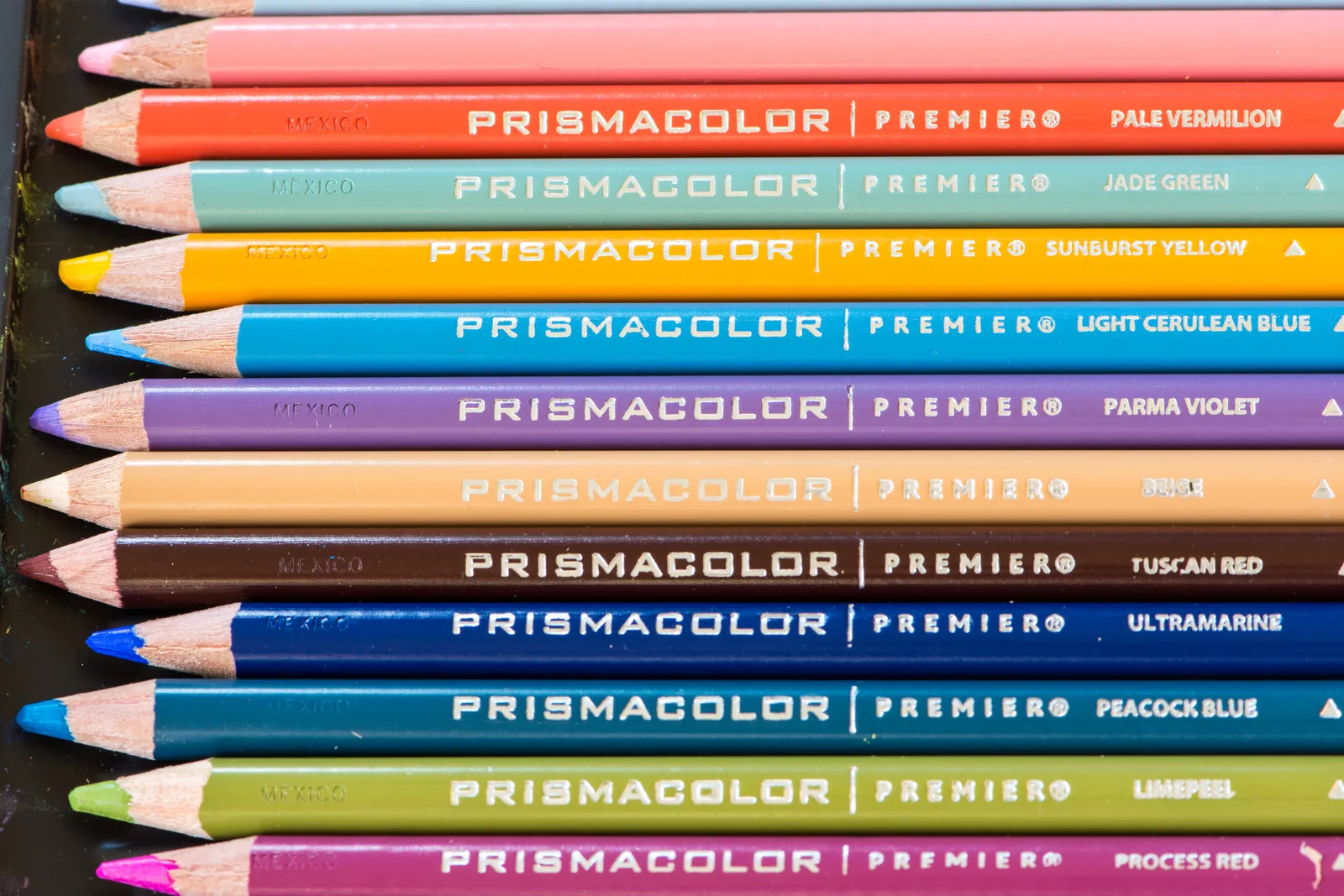
The barrel finish is a matte lacquer with the color name and number printed near the ferrule end (no cap, since these aren't markers — just a sharpened point). After months of handling, the printed labels on my most-used pencils (a couple of skin tones, a dark umber, and my two most common greens) have worn down enough that I sometimes have to check the tip color against the swatch sheet that came in the box. That's a minor annoyance but worth flagging since some reviews imply the labeling is permanent.
The core: wax-based, soft, and why that matters
Prismacolor Premier pencils use a wax-based pigment core, which is the single most important thing to understand before you buy this set, because it drives almost every other characteristic — good and bad — described below. Wax-based cores are softer and lay down pigment more readily than the harder, more clay-heavy cores used in student-grade pencils, which is why a single pass of a Prismacolor pencil looks more saturated and even than two or three passes of a cheaper pencil. The trade-off is that the core is genuinely fragile. I've snapped the tip clean off inside the wood on at least a dozen pencils over eight months, almost always from ordinary use — pressing a little harder than usual on a corner, or a drop from about a foot onto a hard studio floor.
This isn't a manufacturing defect so much as a physical property of the material: a softer core that lays down more pigment per stroke is, almost by definition, going to be more prone to core breakage than a firmer, chalkier core that resists laying down color. If you've used Faber-Castell Polychromos (oil-based, noticeably firmer) or any student set, expect a real adjustment period in how much pressure you apply and how you handle the pencils day to day.
Sharpener choice matters more than I expected
I went through three different sharpeners before landing on one that didn't make the breakage problem worse. A cheap handheld sharpener with a wobbly blade shredded the core on maybe one in five pencils in my first two weeks — the soft wax core just crumbles under an uneven blade angle instead of shaving cleanly. Switching to a quality helical two-step sharpener (I use a Prismacolor-branded one, though a good X-Acto or KUM sharpener does the same job) cut my breakage rate dramatically, to maybe one pencil in every thirty or so sharpenings. An electric sharpener with a soft-core setting works even better for long sessions, though it eats down the pencil length noticeably faster than hand sharpening, which matters over the life of a $110 set.
Point retention is the other side of this coin. Because the core is soft, the tip dulls to a rounded nub within a few minutes of continuous shading work, especially on tooth-heavy paper. For fine detail — eyelashes, individual hair strands, small text — I found myself resharpening every three to five minutes during detail passes, which slows a session down in a way that a firmer pencil simply doesn't. I adapted by keeping two pencils of each frequently used color in rotation: one for broad fills, one kept needle-sharp for detail, swapping as needed rather than constantly stopping to resharpen mid-stroke.
Blending technique: stumps, colorless blender, and burnishing
Where this set earns its price is blending. Layering two or three wax-based colors and then working them together with a blending stump (a tightly rolled paper tool, not included in the set — budget another $5-10 for a few of different sizes) produces genuinely smooth gradients with none of the visible pencil-stroke texture you get from cheaper cores. The wax content means colors physically mix on the paper surface rather than just sitting side by side, so a stump dragged across a red-to-yellow transition pulls real orange into the middle rather than just smudging.
Prismacolor also sells a colorless blender pencil (same soft wax core, no pigment) separately for about $6-8, and it's close to essential if you're serious about smooth work — burnishing a finished area with the colorless blender melts the wax layers together into a glossy, almost painted finish that a stump alone doesn't fully achieve. The technique that took me the longest to learn: burnish in the direction of your existing strokes, in slow, even passes, and only after you've built up at least two or three layers of actual pigment first. Burnishing too early, before enough color is down, just presses white paper tooth into the wax and dulls the result instead of polishing it.
One failure mode worth mentioning: over-layering wax-based pencils on standard drawing paper (I made this mistake on a 90lb sketchbook page early on) eventually saturates the paper's tooth completely, and additional layers stop taking at all — the pencil just skates over a slick, waxy surface instead of depositing more pigment. Heavier, more toothed paper (I switched to a 98lb hot-press mixed-media pad and later a dedicated Stonehenge-style printmaking paper) holds far more layers before hitting that ceiling, and it's a real cost most first-time buyers don't budget for alongside the pencils themselves.
Waxy bloom: the thing nobody mentions on the box
About six weeks after finishing my first heavily-layered piece, I noticed a faint white-gray haze developing across the darker, heavily burnished areas — waxy bloom, a well-documented phenomenon where the wax binder in the pigment core migrates slowly to the surface over time and scatters light, dulling the color underneath. It's not damage and it's reversible: buffing the surface gently with a soft cloth or a bit of cotton restores the original saturation. But if you're framing finished pieces for display (I framed two botanical studies for a gift), it's worth knowing this can recur months later under glass, and it's a real long-term maintenance quirk of wax-based pencils that oil-based sets like Polychromos are less prone to.
Lightfastness for pieces meant to be displayed
Prismacolor publishes individual lightfastness ratings per color rather than a single blanket claim for the whole line, and the range is wider than I expected — some colors (many blues, several earth tones) rate excellent for long-term display, while a handful of the brighter pinks and some fluorescent-adjacent colors in the 72-set are rated poor to fair and will visibly shift or fade within a year or two of direct sunlight exposure. For the two portrait pieces I've actually framed and hung, I cross-checked every color I used against Prismacolor's published lightfastness chart beforehand and avoided the worst offenders for skin tones and backgrounds, substituting a slightly less saturated but more lightfast alternative where needed. If you're coloring purely for a sketchbook that stays closed in a drawer, this doesn't matter much; if you intend to frame and display finished work, it's a step worth taking seriously rather than assuming every color in the tin ages the same way.
Comparison to a student-grade set: Crayola Signature
I bought a 50-count Crayola Signature colored pencil set (about $12) specifically to compare side by side, since it's the kind of set most people already own before deciding whether to upgrade. The difference in a single stroke is immediate: the Crayola core is firmer and noticeably less pigmented, requiring three or four passes to reach a saturation the Prismacolor achieves in one or two. Blending with a stump on the Crayola set produces a chalky, slightly muddy gradient rather than a smooth one, because there simply isn't enough wax and pigment laid down to move around. On the other hand, the Crayola core almost never breaks — I sharpened the same dozen pencils repeatedly over two weeks of testing and had zero core snaps, versus the regular breakage I experienced early on with the Prismacolor set.
For a child's coloring book or casual weekend hobby use, the Crayola set's durability and much lower price make it the more sensible choice — you genuinely don't need Prismacolor-level blending for that use case, and the frustration of constant breakage isn't worth it for occasional use. For anyone doing sustained illustration, portrait, or fine-art work where blend quality and color saturation compound over dozens of hours per piece, the Prismacolor set's pigment density and blendability are worth the fragility and the higher price, in the same way professional-grade materials generally are in any craft.
Who should buy this set
This 72-color tin makes sense for people doing regular illustration, botanical or nature studies, portrait work, or adult coloring books where they want to actually push blending and layering rather than just filling in outlines — students and hobbyists serious enough to accept the sharpening discipline and occasional broken tip as the cost of noticeably better pigment. It's a harder sell if you mostly want to hand pencils to kids for casual coloring sessions, where the fragility and per-pencil cost (over $1.50 each at full retail) will just lead to frustration and frequent replacement. If you're in that second group, a firmer, cheaper set like Crayola Signature or a mid-tier oil-based set is the more practical starting point, with room to upgrade individual colors to Prismacolor open stock later as specific needs come up.
The verdict after eight months
The Prismacolor Premier 72-count set delivers exactly what its reputation promises: rich, buttery pigment that blends and burnishes into genuinely polished finished pieces, at a level a student-grade set simply can't match no matter how many layers you add. That quality comes bundled with real costs beyond the roughly $110-120 sticker price — a soft core that breaks more than firmer alternatives, point retention short enough to demand frequent resharpening during detail work, a sharpener choice that actually matters, waxy bloom that needs occasional buffing on finished pieces, and lightfastness that varies enough by color to require some homework before framing anything for display. None of that makes it a bad set; it makes it a set that rewards people who'll put in enough hours to learn its habits and are willing to treat it like the professional-grade tool it is rather than an ordinary box of pencils. If you're testing whether colored pencil illustration is for you, start with something cheaper and firmer; once you know you'll use it enough to justify the maintenance, this is the set to grow into.
Other products we tested

Ecobee Smart Thermostat Premium Review: Two Months of Real HVAC Testing
We installed the Ecobee Smart Thermostat Premium without a C-wire, tracked its temperature accuracy against a separate thermometer, and measured real energy savings over two months of daily HVAC use.
Bose SoundLink Flex Review: Six Weeks of Hiking, Kayaking, and Beach Days
Six weeks of camping, kayaking, and beach trips show the Bose SoundLink Flex's IP67 rating and PositionIQ orientation sensing are genuinely useful, with honest limits on bass and max volume.
Coros Pace 3 Review: Six Weeks Testing the GPS Watch That Barely Needs Charging
A dual-frequency GPS running watch that trades AMOLED shine for weeks of battery life at a fraction of the price of flagship rivals.