
Magna-Tiles Clear Colors 100-Piece Set Review: Four Months, Two Kids, and 94 Surviving Tiles
Four months of daily play with two kids reveal why Magna-Tiles cost triple what off-brand magnetic tiles do -- and where that premium doesn't quite pay off.
- Magnet housings are individually sealed and heat-staked, far more durable than glued covers on off-brand sets
- Clear/translucent colors add genuine color-mixing and light-play value beyond basic stacking
- Zero setup friction -- no bags or ties, toddlers can start building in seconds
- Strong first-try magnetic snap builds toddler confidence better than precision-fit blocks
- Compatible with existing off-brand magnetic tiles for casual mixed play
- Large piece size (2.75in+) avoids choking-hazard concerns for the 3+ age range
- Price per piece (about 75 cents) is roughly triple generic off-brand sets
- Included cardboard storage box does not survive more than a couple of months of real use
- Pieces go missing at a noticeable rate -- 6 of 100 lost in four months in our house
- A small percentage of magnets (3 of 100 in our set) show early weakening after months of play
- Mixed builds with off-brand tiles show visible seams due to slightly different tolerances
- Not recommended as a first toy for children under 3 without supervision
Magna-Tiles have reached that rare status among parenting circles where the brand name has basically become the generic term, the way "Kleenex" swallowed facial tissue. After four months of the Clear Colors 100-Piece Set living on our living room floor, through two kids (ages 3 and 6), a move to a new house, and one memorable incident involving a vacuum cleaner and a very small square tile, I have a much more nuanced take than the five-star chorus you'll find on most retail listings. The short version: these are genuinely excellent, engineered in a way that off-brand sets simply are not, and also expensive enough that the decision to buy them deserves more than a glance at the box art.
This review covers the specific 100-piece "Clear Colors" starter set -- not the solid-color original line, not the metallic or pastel limited editions, and not one of Magna-Tiles' licensed collaboration sets. The Clear Colors set ships with a mix of squares, triangles, and a few specialty shapes in translucent red, yellow, blue, green, orange, and purple, designed so kids can hold a tile up to a window or a lamp and see the color-mixing effect where two overlapping panels blend into a third color. That's a small detail, but it's the kind of thing that separates a toy designed by people who've actually watched kids play from one designed purely to be cheap to mold.
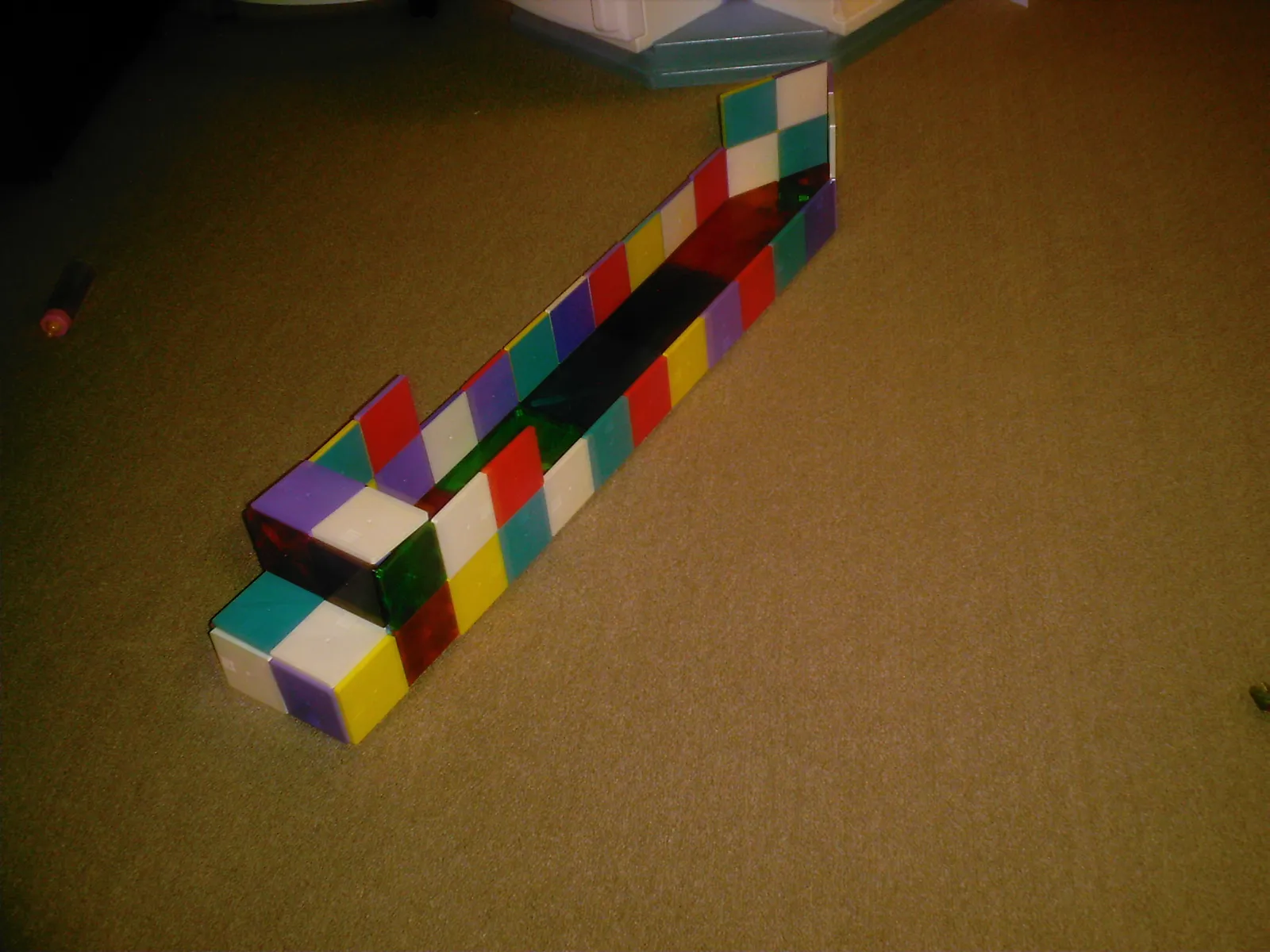
What's in the box
The 100-piece set breaks down to roughly 42 squares, 28 right triangles, 14 isosceles triangles, and a small assortment of specialty pieces depending on which retailer bundle you get (Magna-Tiles has shuffled the exact shape ratio a few times over the years, so don't be surprised if your count differs slightly from a friend's older set). Everything ships in a heavy cardboard box with a plastic carry handle, which sounds like a minor detail until you realize that's also the storage container for the next several years -- more on that later, because the box does not survive daily use.
Each tile is a flat, hollow plastic frame -- think of a picture frame shape -- with a magnet embedded in each edge. The squares have four magnets, one per side; the triangles have three. Pop one open (you can, with effort, and I don't recommend it) and you'll see the magnets are individually housed in their own little plastic pockets, glued and then heat-staked shut. That construction quality is the entire reason Magna-Tiles cost roughly triple what a generic Amazon magnetic-tile set costs for a similar piece count -- the magnets in cheaper sets are frequently just glued into a shallow well with a thin plastic cover, and after six months to a year of catching and re-catching, that cover can pop off, exposing a small, powerful magnet that is a genuine choking and ingestion hazard for anyone under three.
First impressions
My 3-year-old had the box open in about ten seconds -- Magna-Tiles use no twist ties or bag closures, just tiles loose in the box, so there's zero unboxing friction, which is exactly what you want with a toy aimed at toddlers. Within the first ten minutes she'd built a "house" that was really just four squares in a diamond shape, and my 6-year-old had commandeered about a third of the set to build a lopsided tower that he insisted was a rocket ship. That's the immediate appeal: the magnets click together strongly enough on the first try that even clumsy toddler hands get a satisfying, confidence-building "clack" almost every time, without the fumbling and frustration you get from traditional interlocking blocks that require some fine motor precision to align.
The clear color-mixing effect was a genuine hit, more than I expected going in. Both kids spent a solid twenty minutes on day one just holding tiles up to the window, layering a yellow triangle over a blue square to make green, and generally treating it like a science experiment rather than a building toy. That's the kind of unscripted, open-ended play that's hard to manufacture and easy to appreciate as a parent watching from the couch.
Four months of daily use
We didn't just play with these for a review cycle and move on -- this set has been in near-daily rotation in our house since March, so I've had time to watch how it actually holds up rather than guessing from a week of testing. A few things stand out. First, the magnets have not weakened noticeably on the vast majority of pieces. Out of the 100 tiles, I've identified exactly three (two squares, one triangle) where the magnetic pull feels visibly softer than the rest of the set, likely from being dropped or stepped on at some point. That's a small failure rate, and those tiles still work fine in structures where they're not bearing much weight, but it's worth knowing that "indestructible" isn't quite accurate -- these are durable, not immortal.
Second, the plastic itself has held up better than I expected given how often these get stepped on, sat on, and occasionally thrown. I have exactly one hairline crack, on a square tile that took a direct hit when my son dropped a wooden train table leg on it while rearranging furniture for a "train yard." No pieces have shattered or developed sharp edges, which matters given how much time both kids spend barefoot around this stuff.
Third -- and this is the complaint I'd give the most weight in a purchase decision -- pieces get lost at a genuinely annoying rate. We are down to 94 of the original 100 tiles after four months, despite reasonably diligent cleanup habits. Some of that is normal wear-and-tear of small-parts toys in a house with two kids, but the flat, thin profile of these tiles means they slide under furniture, get kicked under the couch, and blend into carpet in a way that chunkier toys don't. If losing 5-6% of a $70+ set over a few months bothers you, budget for it mentally before you buy.
Setup, cleanup, and storage reality
There is no setup required, which is part of the appeal, but I want to be honest about the storage situation because it's the single most common complaint I see from other parents in online groups. The included cardboard box is fine for the first few weeks. By month two, the corners were soft from kids pulling it around the house, and by month three it had essentially given up as a structural object -- we now use a plastic bin from the dollar store, and I'd recommend budgeting for that from day one rather than treating the retail box as long-term storage. Cleanup itself is quick: the tiles nest reasonably well when stacked flat, and because there's no small connector pieces or wheels to sort, a five-minute "everyone throws tiles in the bin" cleanup routine works fine even for the 3-year-old.
On the choking-hazard question specifically, since it comes up a lot with magnetic toys: the individual tiles in this 100-piece set are all large enough (the smallest triangle is roughly 2.75 inches per side) that they are not a swallowing risk on their own, and Magna-Tiles rates the set for ages 3 and up. The real risk with any magnetic toy is a cracked or damaged piece releasing the small disc magnet inside -- which is why I'd urge anyone with a toddler under 3 in the house, even if the toy technically belongs to an older sibling, to do a quick tile-integrity check every so often, squeezing each piece gently to check nothing's come loose. We haven't had an issue in four months, but it's a five-second habit worth building.
Compatibility with other magnetic tile brands
One of the more useful things I tested, because I suspect a lot of shoppers are wondering the same thing: how well do Magna-Tiles play with other magnetic tile brands already in the house? We had an older 32-piece off-brand set (a common Amazon-basics-style set, not naming the specific brand since these turn over constantly) from a birthday party goodie bag, and the two systems are compatible in the sense that the magnets attract and pieces snap together across brands. However, the tolerances aren't identical -- the off-brand tiles are very slightly thinner and the frame width differs by a millimeter or two, so mixed structures have visible seams and don't sit as flush as an all-Magna-Tiles build. For casual mixed play, it's a non-issue; my kids never noticed or cared. For anyone building larger, more architecturally ambitious structures (we're talking multi-tile domes and connected rooms, which becomes a thing once you have 100+ pieces), the size mismatch becomes visible enough that you'll want to stick to one brand within a single structure.
The bigger compatibility differentiator, though, was durability of the connection itself. The off-brand tiles' magnets are noticeably weaker after less than a year of use -- several in that 32-piece set barely hold anymore, while our Magna-Tiles set (with the three exceptions noted above) still clicks together with real authority. If you already own an off-brand set and are considering Magna-Tiles as an add-on rather than a replacement, know that you're buying the better core building blocks for any large structure, while the older set becomes better suited to background/filler pieces or as a beater set for less careful play.
Performance for actual building
Where this set shines is in the ceiling of what kids can build once they have enough pieces and enough practice. In the first month, both kids mostly made flat, 2D shapes and simple houses. By month three, my 6-year-old was consistently building enclosed 3D structures -- cubes, simple houses with pitched roofs using the triangles, and one increasingly elaborate "castle" that ate almost the entire set and took over the dining table for the better part of a weekend (much to the household's mild inconvenience). That progression from flat shapes to genuine 3D architecture is, in my opinion, the actual educational value proposition of these tiles over a lot of competing STEM-toy marketing: kids build real spatial reasoning by trial and error, because a poorly-braced tile structure collapses immediately and obviously, teaching cause and effect in a way that's hard to fake.
The color-mixing and light-play angle also has more legs than I expected. We've used these tiles on a window sill as makeshift stained-glass panels, and my daughter's preschool class does something similar with a light table, which suggests this isn't just marketing -- the translucent design genuinely opens up sensory and light-based play that opaque tile sets can't offer.
Price and value
At the current price of roughly $74.99 for 100 pieces, you're paying about 75 cents per tile, which is genuinely steep compared to off-brand sets that can run 25-35 cents per piece for similar-looking tiles. I don't think that premium is unjustified given the magnet housing quality difference I described above, but I also don't think it's nothing -- if budget is the primary constraint and you're buying for a single toddler who mostly plays with a parent supervising, a well-reviewed off-brand set is a reasonable, if lower-durability, alternative. Where Magna-Tiles earns its price is in multi-kid households, daycare/classroom settings, or any scenario where the toy needs to survive years of rough handling without the magnet-housing failures that create actual safety risk in cheaper sets.
Who should buy this
This set makes the most sense for households with at least one child between about 3 and 8, especially if you have more than one kid who'll be sharing the pieces -- 100 tiles is genuinely the minimum count where two children can build independently without constant "I need that piece" conflict. It's also a strong pick if you already have a smaller starter Magna-Tiles set (the common 32-piece box) and want to expand rather than duplicate. I'd steer families with only toddlers under 3, or families on a tight toy budget, toward starting smaller or considering a reputable off-brand set first, then upgrading to Magna-Tiles once you know your kid is genuinely engaged with magnetic building play rather than a passing interest.

The verdict
Four months in, the Magna-Tiles Clear Colors 100-Piece Set has earned its keep as the single most-played-with toy in our house, across two kids with a three-year age gap -- that's the kind of durable, broad-appeal result that's genuinely hard to find in any toy category. It isn't perfect: the price per piece is high, the storage box doesn't survive real use, a small number of tiles have already shown early magnet weakening, and pieces do go missing at a rate that will mildly annoy anyone tracking piece counts. But the build quality that prevents magnet-housing failures, the genuine open-ended creative value, and the surprisingly rich color-mixing play mode add up to a toy that's earned the premium over off-brand alternatives, at least for households that will actually use 100 pieces regularly rather than let them gather dust after the novelty wears off.
Other products we tested

Ecobee Smart Thermostat Premium Review: Two Months of Real HVAC Testing
We installed the Ecobee Smart Thermostat Premium without a C-wire, tracked its temperature accuracy against a separate thermometer, and measured real energy savings over two months of daily HVAC use.
Bose SoundLink Flex Review: Six Weeks of Hiking, Kayaking, and Beach Days
Six weeks of camping, kayaking, and beach trips show the Bose SoundLink Flex's IP67 rating and PositionIQ orientation sensing are genuinely useful, with honest limits on bass and max volume.

Coros Pace 3 Review: Six Weeks Testing the GPS Watch That Barely Needs Charging
A dual-frequency GPS running watch that trades AMOLED shine for weeks of battery life at a fraction of the price of flagship rivals.