
Lamy Safari Review: Four Months, One Notebook and Some Genuinely Bad Paper
Ten-second nib swaps, a clip that never slips and flawless start-up over four months — but the triangular grip is non-negotiable and the F nib feathers on cheap office paper.
- Wrote on the first stroke every time after a week capped, across four months
- Friction-fit nibs swap in about ten seconds for $12-15 each
- Heavy wire clip grips thick material and never slipped off a pocket
- 17 g filled — no hand fatigue over two-hour writing sessions
- ABS body survived loose bag carry with no cracks or stress marks
- Moulded triangular grip enforces one hand position and cannot be worked around
- F nib runs wide and wet; feathers and shows through on 70 gsm paper
- Uses proprietary Lamy T10 cartridges, not international standard
- Z28 converter is a separate $6 purchase and effectively mandatory
- Cap does not post securely and works loose while writing
- Heavy clip makes the pen roll off sloped surfaces
- Wet ink smudges consistently under a left-handed underwriting grip
The Lamy Safari is the pen recommended to every person who has ever asked where to start with fountain pens, which makes it suspiciously easy to over-praise. I used a fine-nib Safari as my only pen for four months — meeting notes, letters, filling most of a notebook — and deliberately paired it with the cheap 70 gsm paper most offices actually have, because a pen that only works on premium paper is not a practical daily pen.
It is very good, it costs about $32, and it has two design decisions that will make some people dislike it immediately. Neither is a flaw exactly, but both are non-negotiable.
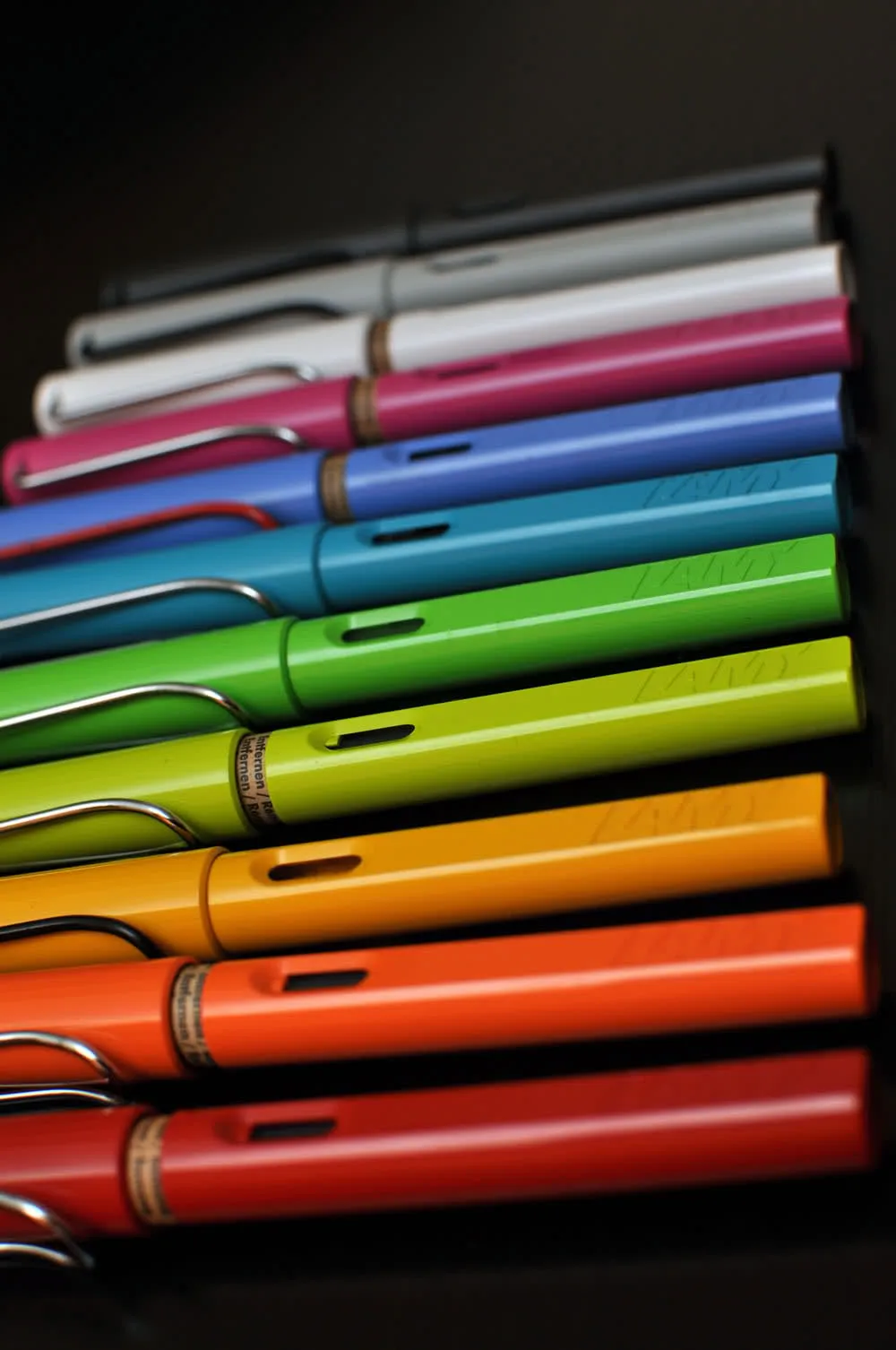
The grip section is the divisive part
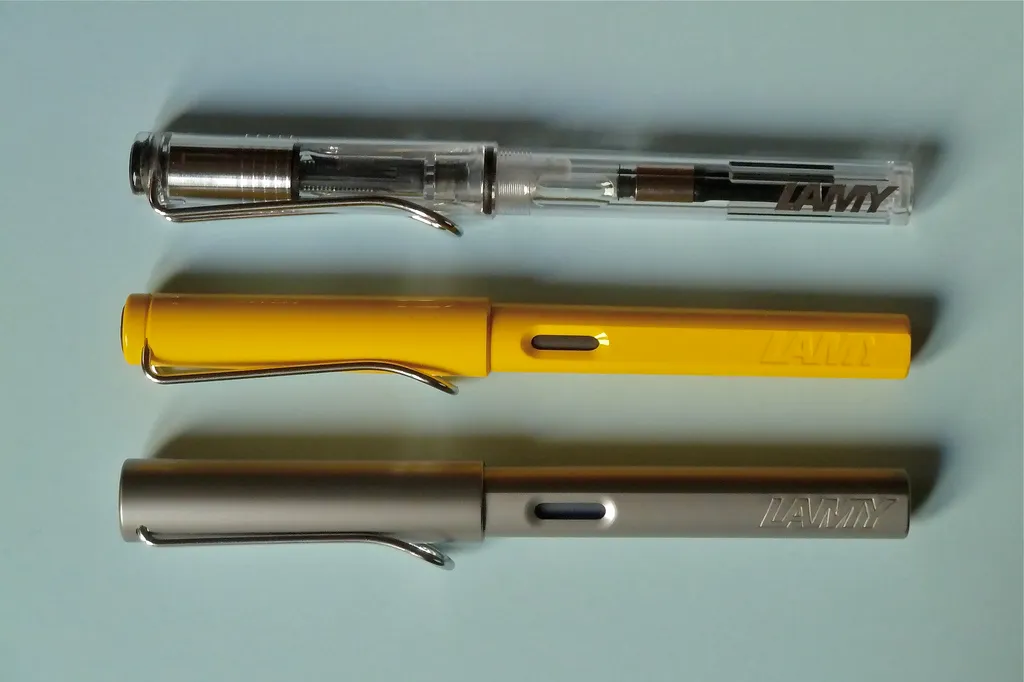
The Safari has a moulded triangular grip with two flat facets for thumb and index finger. It was designed for schoolchildren learning to hold a pen correctly, and it enforces a specific tripod grip absolutely.
If your natural grip matches, as mine roughly does, it is comfortable and you stop noticing it within a day. If you hold a pen rotated, or with an overlapping thumb, or between the index and middle finger, the facets will fight you constantly and there is nothing to be done about it — you cannot rotate the pen to a comfortable angle because the flats put you back where Lamy wants you.
This is genuinely the single largest reason people bounce off the Safari, and it is impossible to know from a review whether it affects you. If you can hold one in a shop for thirty seconds before buying, do.
The nib, and how it writes on bad paper
I bought the fine (F) nib. Lamy's steel nibs run wider than Japanese equivalents, and the F writes a line closer to what a Japanese medium would produce — around 0.5 mm on absorbent paper. Anyone with small handwriting should consider the extra-fine.
On decent 90-100 gsm paper it is a smooth, wet, generous writer with no skipping across four months of use. On the cheap 70 gsm office paper I deliberately tested, the wetness becomes a problem: visible feathering along strokes and clear show-through, roughly the same result I got from a medium-nib pen on Moleskine paper. The pen is not at fault, but if your paper is thin, choose the EF nib and a drier ink and expect compromises.
Start-up reliability has been excellent. Left capped for a week, it wrote on the first stroke every time. Left uncapped on a desk for about ten minutes it needed one firm stroke to restart, which is normal.
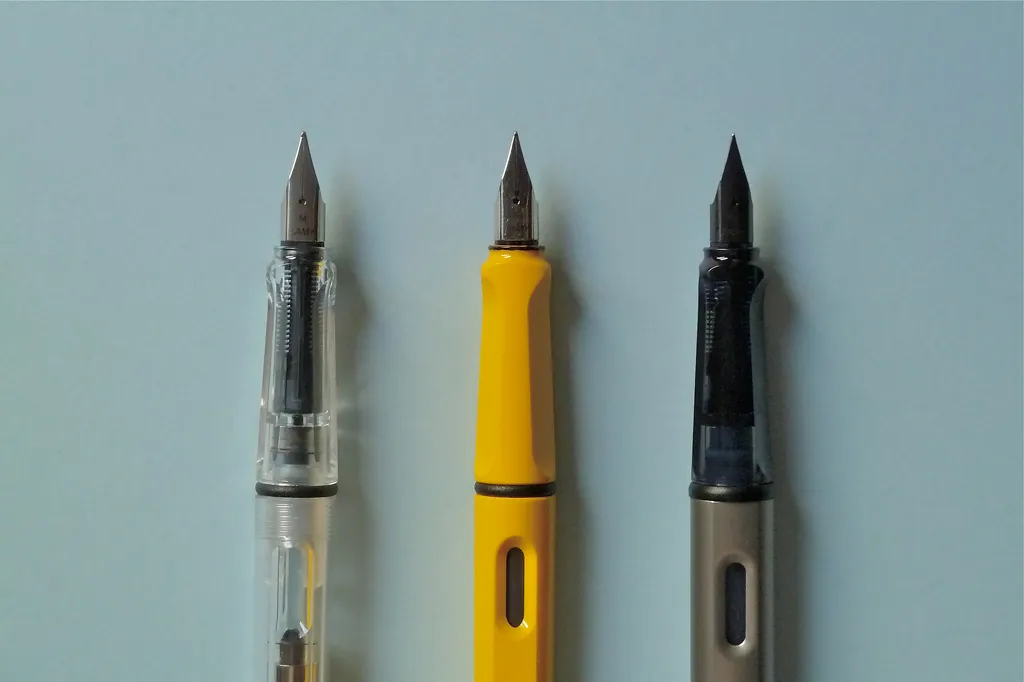
Swappable nibs are the underrated feature
Lamy steel nibs are friction-fit and pull straight off the feed. Swapping one takes about ten seconds using a strip of tape for grip, and replacement nibs cost around $12-15 in EF, F, M, B and a couple of italic widths.
I did this twice during the test, moving from F to EF for thin paper and back. It works exactly as described, with no leaking and no realignment needed. That means one $32 pen body can be four different pens for $15 a time, which is a genuinely unusual amount of flexibility at this price and something no comparable pen offers as easily.
Filling it: the converter you have to buy separately
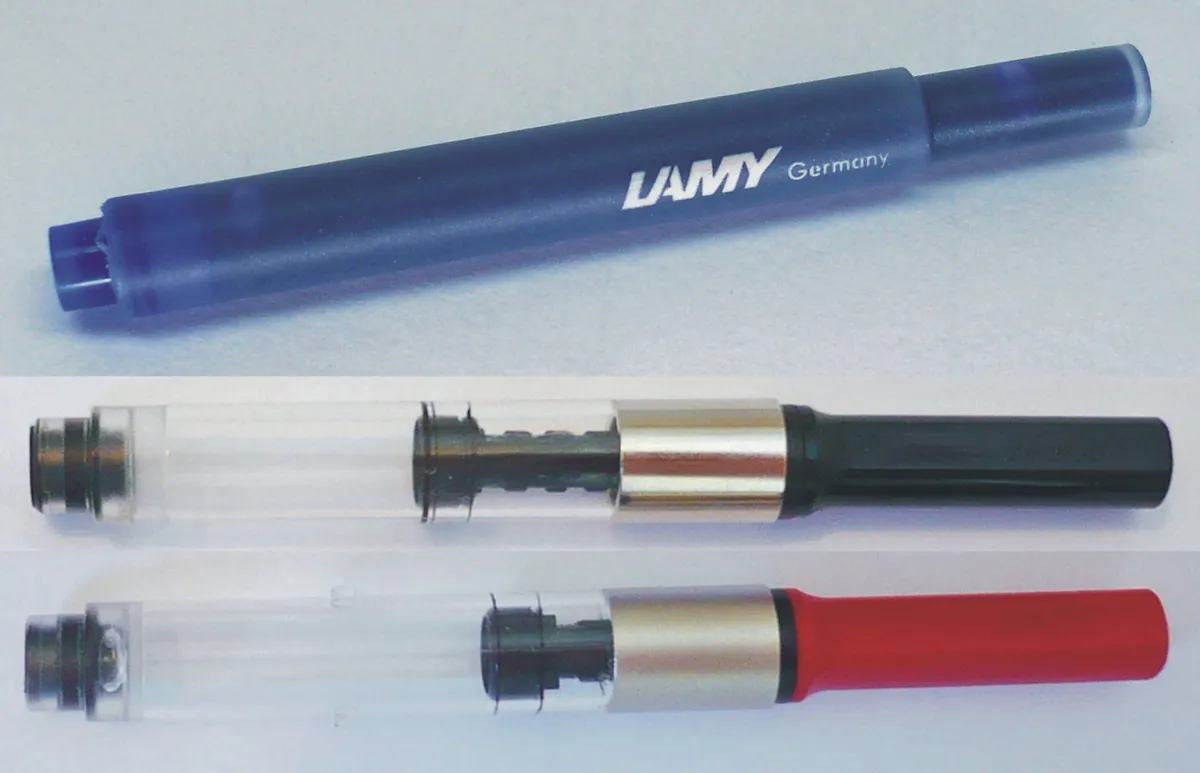
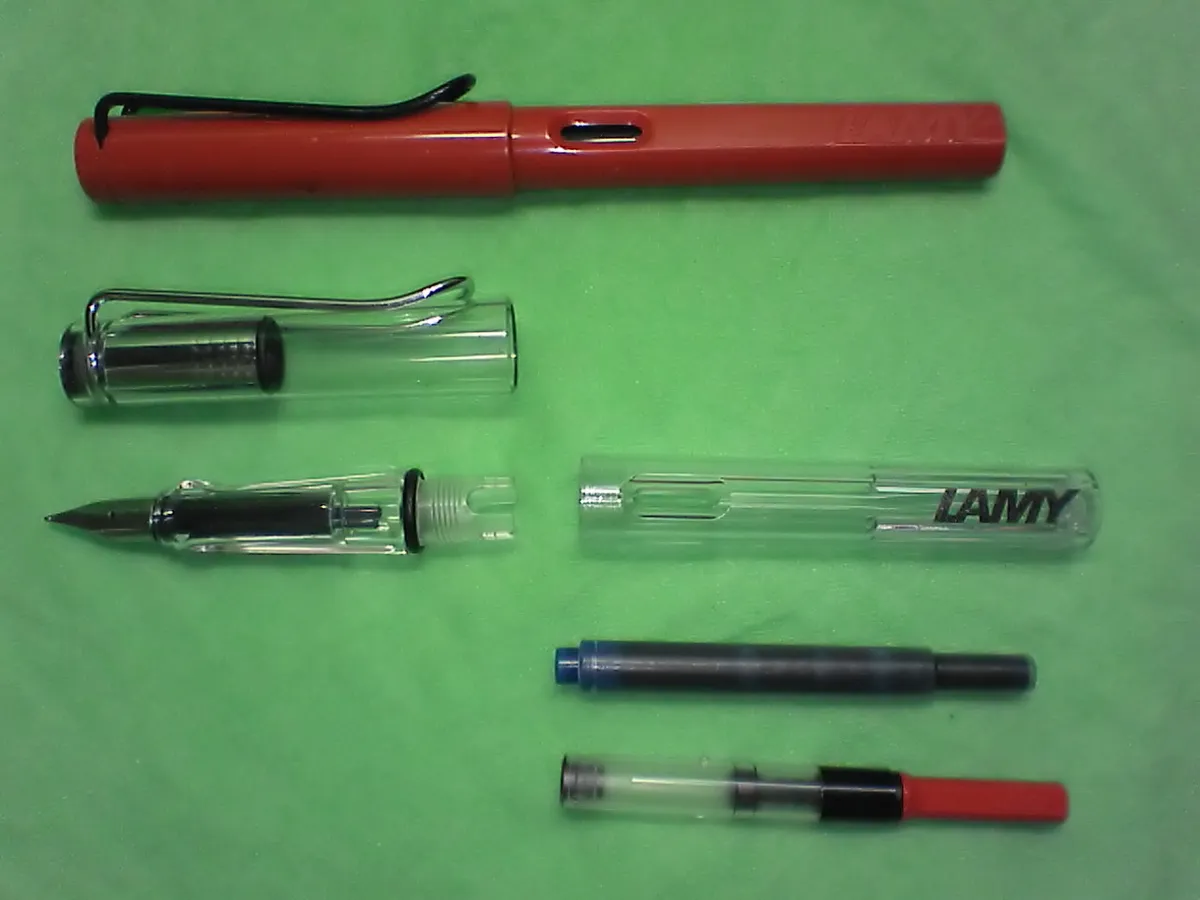
The Safari ships with one Lamy proprietary ink cartridge and nothing else. It uses Lamy's own T10 cartridges, not international standard ones, which locks you into their ink colours unless you buy a converter.
The Z28 converter costs about $6 and is, in my view, mandatory. With it you can fill from any bottled ink, which is where fountain pens become interesting and also considerably cheaper — a $15 bottle of ink is several years of writing versus roughly $1 per cartridge.
Capacity is the trade. The converter holds about 0.8 ml, which gave me roughly two and a half weeks of daily note-taking. A cartridge holds slightly more. Neither is a lot, and I carried a spare cartridge as backup for the first month before deciding it wasn't necessary.
The other divisive design choice: the clip
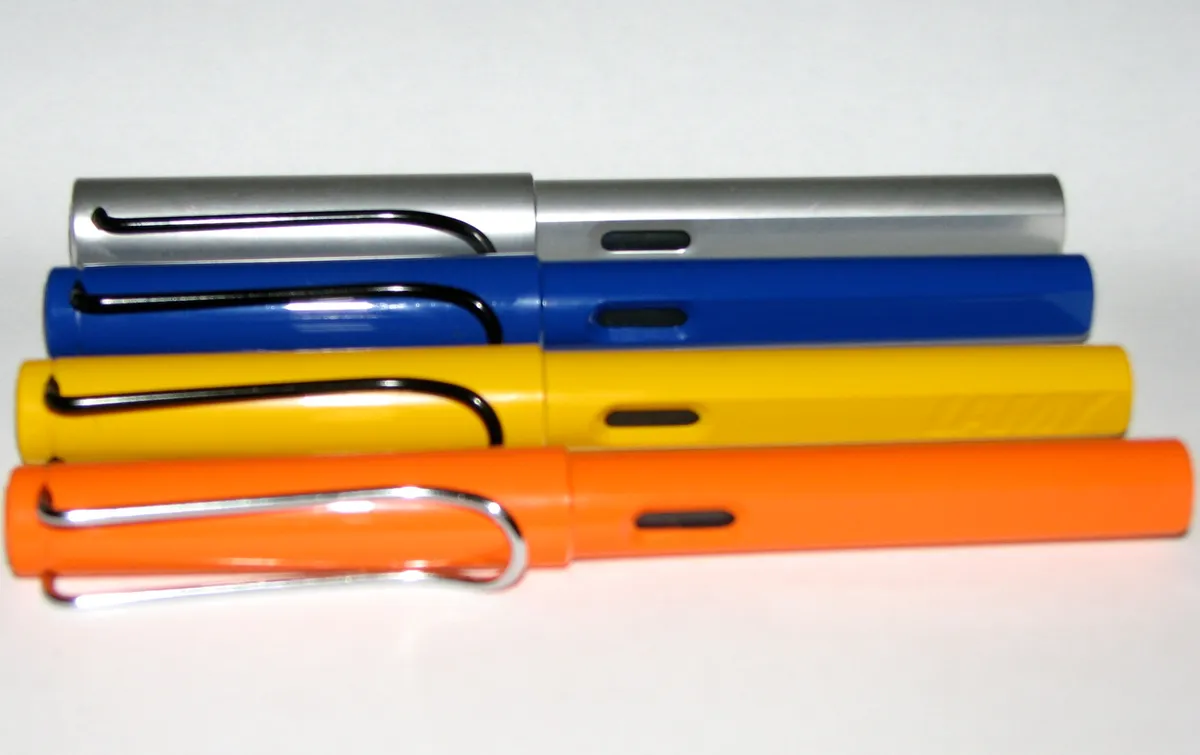
The clip is a heavy chrome wire loop standing well proud of the barrel. It is the pen's visual signature and it is genuinely functional — it clips onto thick material a thin clip would refuse, and it has never slipped off a shirt pocket or a notebook cover in four months.
What it also does is roll. The clip's mass means the pen does not sit still on a sloped surface, and I have watched it roll off a table twice. Nothing broke — the ABS body is tough and the cap protects the nib — but a pen that rolls is an odd thing to design deliberately.
The cap is a snap fit with a firm click. It seals well enough that four months produced no dried-out nib and no ink creep into the cap. It does not post securely, though: pushing it onto the back of the barrel holds, but loosely, and it works free while writing. I stopped posting it after the first week.
Four months of wear
The ABS plastic body is the reason this pen is $32 rather than $60, and it has held up far better than that implies. No cracks, no stress marks at the threads, and the matte finish shows fingerprints less than the glossy versions do.
The nib shows no visible wear and writes identically to day one. The ink window in the barrel — a small transparent slot — has yellowed very slightly, which is cosmetic.
The one real complaint is the converter's piston knob, which stiffened around month three from dried ink. Rinsing the converter in warm water for a couple of minutes fixed it and it hasn't recurred since I started flushing the pen monthly. That monthly flush is roughly five minutes of running water through the section, and it is the entire maintenance requirement.
Writing volume and comfort over long sessions
The pen weighs 17 g filled, which is light. For a two-hour writing session that lightness is the point — there's no fatigue, and a fountain pen needs no pressure at all, so the hand stays relaxed in a way a ballpoint doesn't allow.
Left-handed writers should know that the wetness is a real issue. I tested with a left-handed colleague for two afternoons and the standard ink smudged consistently under an underwriting hand. A fast-drying ink helps substantially; an EF nib helps more. It is workable rather than ideal.
Inks tested, and why the choice matters more than the pen
I ran four inks through it: Lamy's own blue cartridge ink, a standard bottled blue-black, a well-known fast-drying blue, and an iron-gall black. On 70 gsm paper the differences were larger than the difference between nib widths.
The fast-drying ink was the single most useful change. Feathering dropped visibly and dry time on cheap paper went from around six seconds to about two, which makes the pen usable for meeting notes where you flip a page immediately. The iron-gall black was the crispest line of the four and also the one that needed the most diligent flushing — I would not leave it sitting in a pen unused for weeks.
None of the four caused a hard start, a skip or a clog in four months. The Safari's feed is generous enough to handle whatever you put in it, and that tolerance is part of why it gets recommended to beginners: the pen will not punish you for a bad ink choice, it will just write a wider line than you wanted.
Against the alternatives
Against a $4 Platinum Preppy or a $15 Pilot Metropolitan, the Safari costs more and gives you swappable nibs, a much better clip and a tougher body. The Pilot writes a genuinely finer line and has a round grip section, which makes it the better recommendation for anyone unsure about the triangular grip.
Against the Lamy AL-star at about $45, you get an aluminium body and a slightly cooler feel in the hand. It is the same pen otherwise — same nib, same grip, same clip. The extra $13 buys metal and nothing else.
Against a $150 gold-nib pen, the Safari's steel nib is stiffer and less expressive, and the body is plastic. It also costs a fifth as much and I would take it to a building site.
Who should buy this
Buy it if you want to try fountain pens properly for around $38 all in, if your grip is a standard tripod, and if you'll add the Z28 converter on day one. Buy the EF nib if your handwriting is small or your paper is thin — which, in most offices, it is.
Skip it if you hold a pen unconventionally, because the triangular grip is not negotiable. Skip it if you're left-handed and unwilling to hunt for a fast-drying ink. And skip it if you expect to write on cheap copier paper all day, because the wet nib and thin paper are a poor match no matter which pen you buy.
Verdict
Four months and most of a notebook in, the Safari has done everything I wanted from a $32 pen: started first time every time, survived being carried loose in a bag, and let me swap nibs in ten seconds for the cost of a coffee. The clip is excellent, the body is tougher than its price suggests, and monthly maintenance is a five-minute rinse. Against that: the triangular grip is a hard requirement rather than a preference, the F nib is wet enough to feather on cheap paper, the converter is a separate purchase, it doesn't post securely and it rolls off tables. Excellent value with two conditions attached.
Other products we tested

Ecobee Smart Thermostat Premium Review: Two Months of Real HVAC Testing
We installed the Ecobee Smart Thermostat Premium without a C-wire, tracked its temperature accuracy against a separate thermometer, and measured real energy savings over two months of daily HVAC use.
Bose SoundLink Flex Review: Six Weeks of Hiking, Kayaking, and Beach Days
Six weeks of camping, kayaking, and beach trips show the Bose SoundLink Flex's IP67 rating and PositionIQ orientation sensing are genuinely useful, with honest limits on bass and max volume.
Coros Pace 3 Review: Six Weeks Testing the GPS Watch That Barely Needs Charging
A dual-frequency GPS running watch that trades AMOLED shine for weeks of battery life at a fraction of the price of flagship rivals.