
IKEA Billy Bookcase Review: Seven Months, Three Units, and 4 mm of Sag
Fine indefinitely with paperbacks, measurably sagging within four months under art books — the Billy's limits are entirely predictable, and two assembly steps decide the outcome.
- Around 42 minutes to assemble solo by the third unit, with accurate instructions
- No perceptible shelf deflection under an 11 kg paperback load after seven months
- Foil surface has not chipped or peeled and wipes clean
- Huge ecosystem of extensions, doors and modifications that genuinely fit
- A plywood replacement shelf costs about $15 and removes the sag problem entirely
- 80 cm shelves sagged a measured 4 mm under 26 kg of hardbacks within four months
- Particleboard swells permanently within hours of a water spill
- Must be wall-anchored — a loaded 202 cm unit is a genuine tipping hazard
- Supplied anchor hardware is inadequate for plasterboard without extra fixings
- Fixed middle shelf constrains layout for tall books
- Does not survive repeated disassembly; the third rebuild was noticeably looser
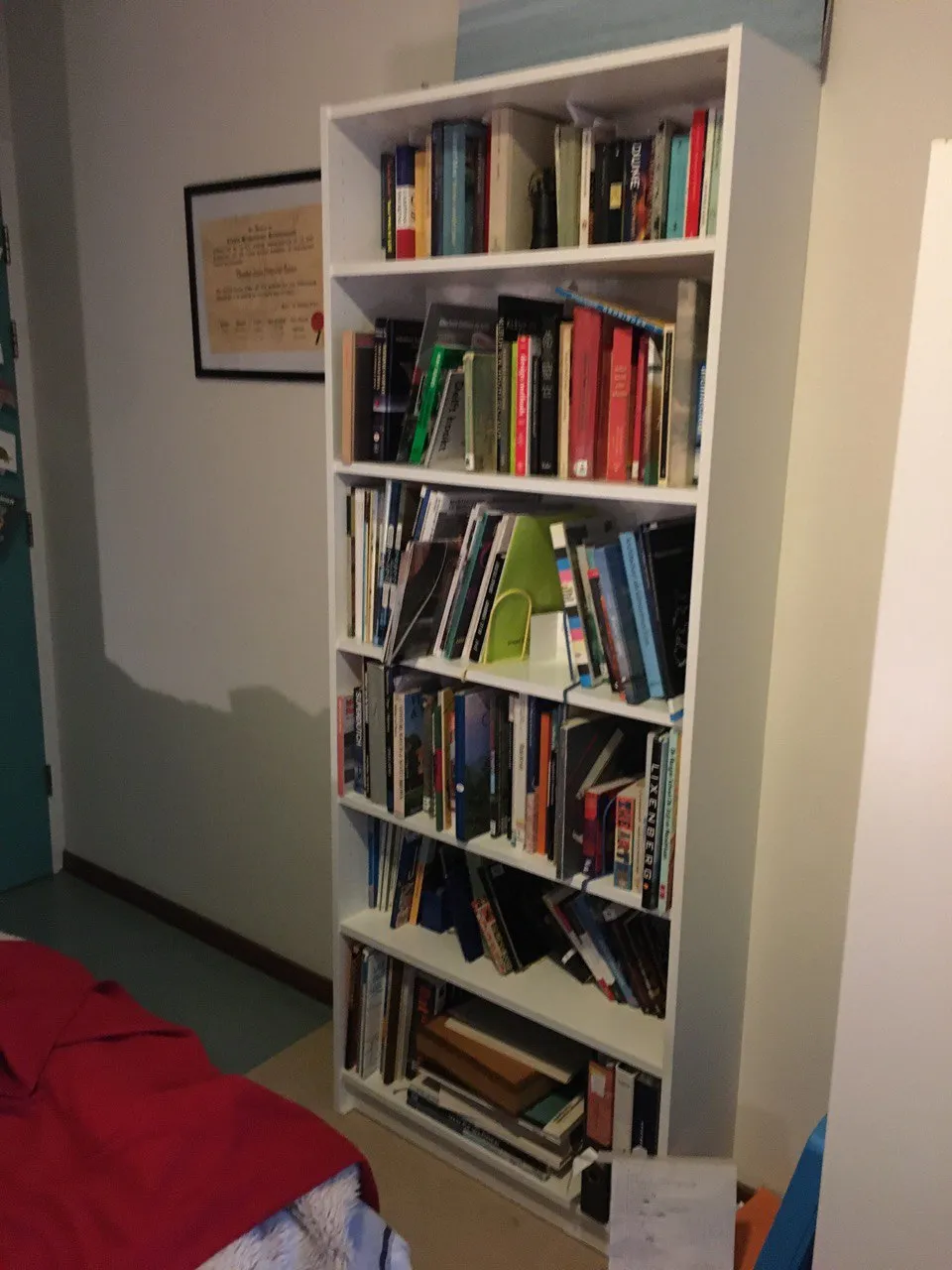
The IKEA Billy is reportedly sold somewhere around every few seconds worldwide, which means most opinions about it are secondhand. I assembled three of them — two 80 cm wide units and one 40 cm — loaded them with actual books rather than decorative objects, and have lived with them for seven months. Two are wall-anchored in a home office, one is in a bedroom, and one of them is now visibly bowed.
This review is about where a $79 bookcase is genuinely good, and about the specific, predictable ways it fails — because the failures are entirely a function of what you put on it and whether you followed one step in the instructions.
What it is made of, and why that matters
The Billy is particleboard with a printed foil or veneer surface, a honeycomb-paper-filled core in the thicker panels, and a hardboard back roughly 3 mm thick that nails on. It is not plywood and it is not solid wood, and every strength and weakness follows from that.
The strength is cost and consistency. At around $79 for the 80 x 202 cm unit, you get a straight, square, flat-packed carcass that will look identical to the one your neighbour bought. The weakness is that particleboard has poor resistance to sustained bending load, does not tolerate moisture at all, and cannot be repeatedly disassembled without the cam-lock holes wearing loose.
Assembly: 42 minutes, one genuine trap
I timed the first build at 61 minutes and the third at 42, working alone. The instructions are the usual wordless IKEA diagrams and they are accurate. You need your own hammer and a Phillips screwdriver; the supplied Allen key handles the rest.
The trap is the back panel. It arrives as a single large hardboard sheet that you nail on with about thirty small nails, and it is the only thing preventing the carcass from racking into a parallelogram. Two things go wrong here. First, people skip nails to save time — don't; the nail spacing is what makes the unit rigid. Second, and much worse, it is entirely possible to nail the back on with the carcass slightly out of square, which locks in a permanent lean. Check with a tape measure diagonally corner to corner before you drive a single nail. Both diagonals should match within a couple of millimetres.
Assemble it lying flat on the floor and stand it up afterwards. In a room with a standard 244 cm ceiling, standing a 202 cm unit up from flat needs about 30 cm of clearance to swing through — tight but manageable. In a room with a low ceiling or a sloped one, measure first, because there is no good recovery from discovering this halfway through.
The shelf sag, quantified
This is the thing everyone warns about and it is real, but it is more specific than the folklore suggests. The 80 cm wide shelves are 74 cm between supports and roughly 17 mm thick. Loaded with mass-market paperbacks — about 11 kg per shelf on my kitchen scale — I measured no perceptible deflection after seven months.
Loaded with hardbacks and a run of art books, one shelf carried about 26 kg. After roughly four months that shelf shows a measurable 4 mm of sag at the centre, visible against a straightedge and now visible to the naked eye if you look along it. It has not failed and I don't expect it to, but it will not recover — particleboard creeps permanently under sustained load.
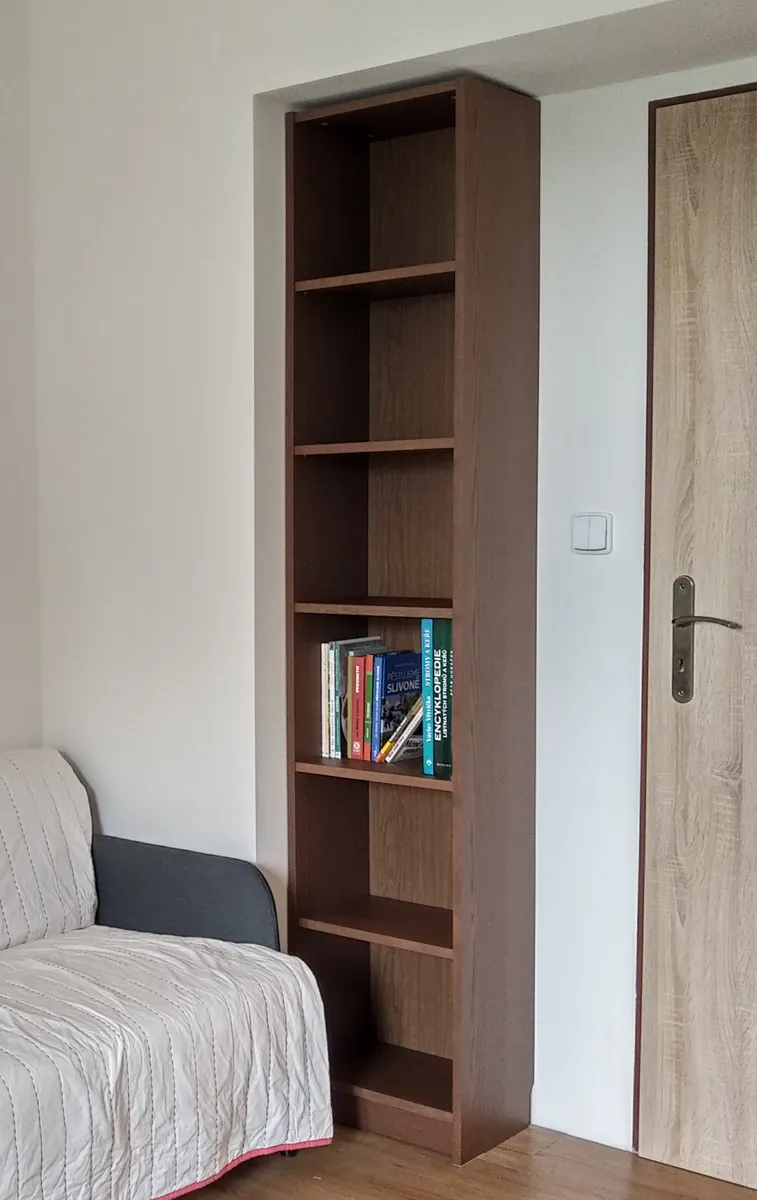
The 40 cm wide unit shows nothing at all under the same load per unit area, because the span is halved. If you own heavy books, the narrow Billy is structurally the better buy, and two narrow units side by side cost slightly more than one wide one for the same total shelf length.
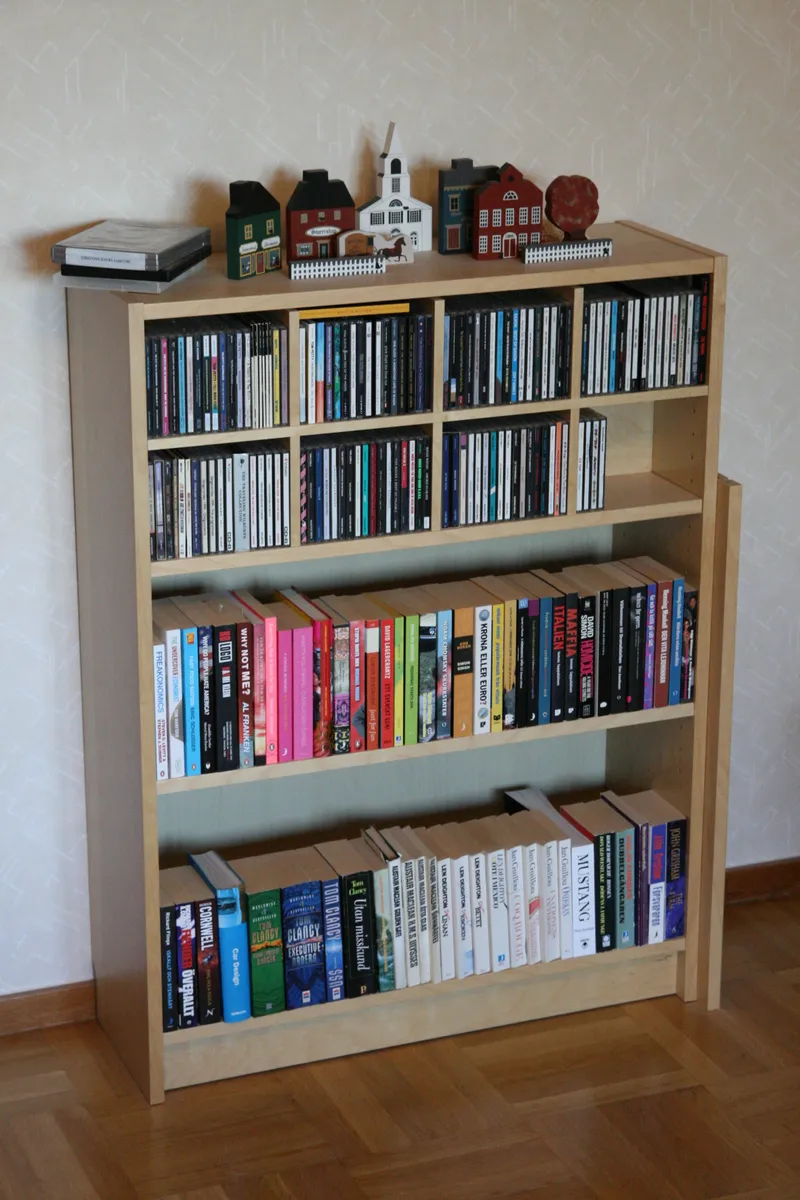
The practical mitigation, if you already own a wide unit: put the heaviest books on the fixed bottom shelf and the lowest adjustable shelf, keep heavy loads to the shelves nearest the floor, and flip a sagging shelf over. Flipping buys you time and looks fine; it does not solve the problem twice.
The wall anchor is not optional
A 202 cm tall, 28 cm deep bookcase is a tipping hazard, and this is the one part of this review where I'm not going to hedge.
Anchor it to the wall. IKEA supplies a bracket and screws for exactly this reason, and tall furniture tipping onto children has caused deaths. A loaded Billy weighs well over 100 kg and a child climbing the lower shelves can bring it down. If you rent and can't drill, do not buy a 202 cm unit — buy the 106 cm version, which is short enough to be far less dangerous.
The supplied hardware is for a solid wall or a stud. Into plasterboard alone it is not adequate; you need proper toggle or expanding anchors rated for the load, which cost a few dollars at any hardware shop. I found the stud with a magnet and a $10 detector, and the whole job took ten minutes per unit.
Living with it for seven months
The foil surface has held up better than expected. No chips, no peeling at the edges, and it wipes clean with a damp cloth. It does scratch if you drag something heavy across a shelf, and the scratch shows the particleboard colour underneath, which is not repairable in any convincing way.
The adjustable shelves sit on small metal pins in a ladder of holes. Moving a shelf takes about thirty seconds once it's empty, and the pins have not loosened. The fixed middle shelf is not adjustable and dictates the layout more than you'd like — my tallest books don't fit in the middle section and had to go on the bottom.
Moisture is the one hazard I'd flag from experience: a spilled glass of water on the bottom shelf of the bedroom unit swelled the edge of the particleboard within a few hours, and that swelling is permanent. It's cosmetic in my case. On a bathroom or basement wall it would be a genuine problem.
Modifications, which the community has largely solved
Because these are everywhere, the modification ecosystem is enormous. The two I've done are worth mentioning. Replacing a sagging shelf with a 18 mm plywood cut to 74 x 26 cm cost about $15 and completely eliminates the sag problem for heavy loads. And adding a strip of 20 x 20 mm timber glued and screwed along the underside front edge of a shelf stiffens it dramatically for almost nothing — invisible once books are in place.
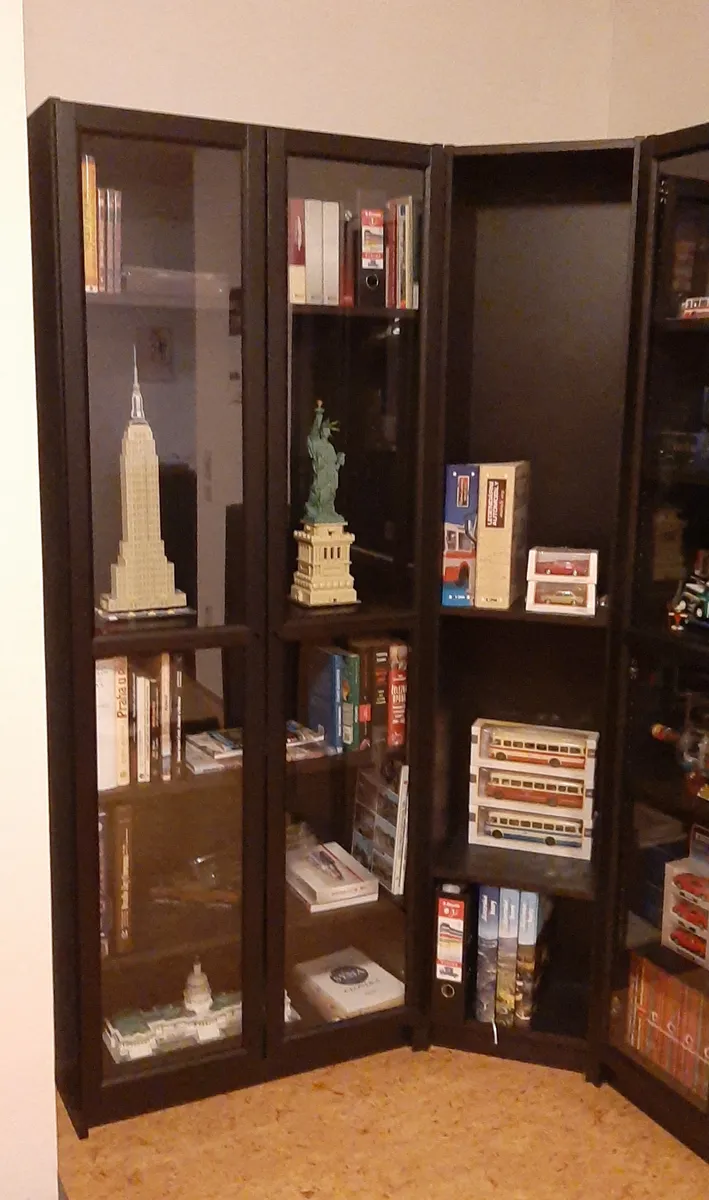
IKEA's own extension unit and glass doors both fit as designed, and the height extension unit is genuinely useful for tall ceilings. Worth knowing: the extension needs the main unit anchored, since it makes an already tall thing taller.
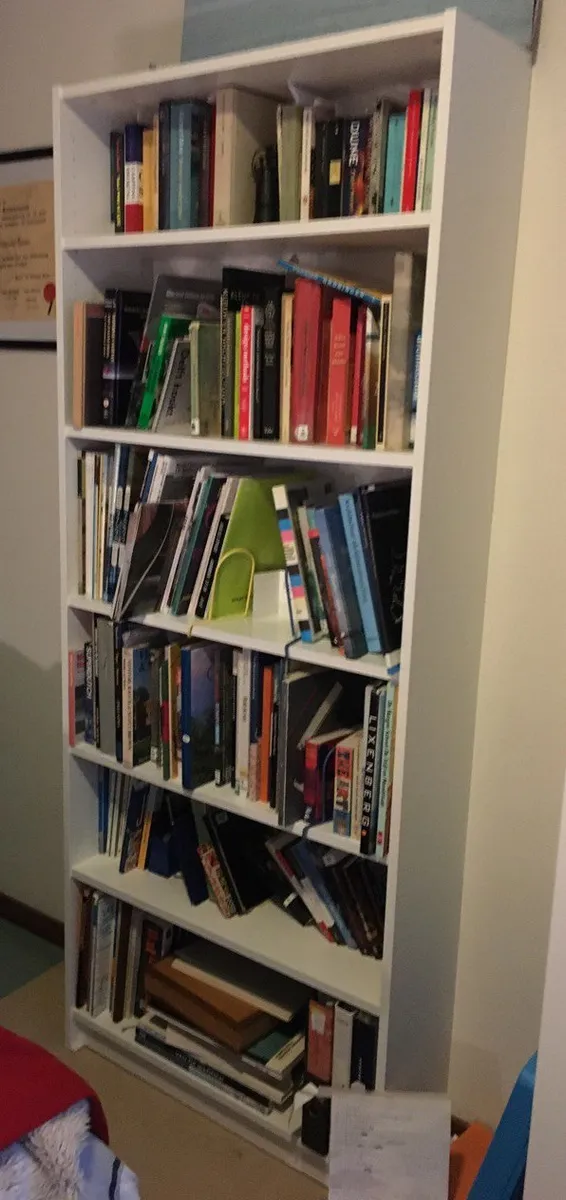
What three units together actually look like
Two 80 cm units and one 40 cm unit stood side by side read as a single built-in run rather than three separate objects, which is most of the reason people buy multiples. The carcasses butt together with about a 3 mm gap where the side panels meet, and that gap is visible from an angle but disappears once books are in. IKEA sells no official joining hardware for this, so mine are simply anchored individually and pushed tight.
The one alignment problem is floors. My office floor drops about 8 mm across the width of the run, which put the tops of the three units visibly out of line. There are no adjustable feet, so the fix was two thin plastic shims under the low end — cheap, invisible, and something worth checking with a spirit level before you anchor anything to a wall.
Against the alternatives
Against a $250 solid pine bookcase, the Billy loses on load capacity, longevity and repairability and wins decisively on price and on looking clean and modern rather than rustic. Against a $40 wire or metal shelving unit, the Billy looks like furniture and the wire unit looks like storage; the wire unit will hold far more weight.
Against building your own from plywood, the maths is closer than people assume — a sheet of decent 18 mm birch ply is not far off the price of two Billys and requires tools, time and a way to transport it. The Billy's real competitive advantage is that it is available today, fits in a car, and costs less than the books that will go on it.
Who should buy this
Buy it if you own mostly paperbacks and normal-weight books, if you can anchor it to a wall, and if you want something that looks tidy for under $100. Buy the 40 cm width if your books are heavy, and buy the 106 cm height if you have small children or cannot drill.
Skip it if you're storing large-format art books, vinyl records or anything similarly dense on wide shelves — it will sag and you'll be replacing shelves within a year. Skip it for damp rooms. And skip it if you expect to move house repeatedly, because these do not survive disassembly and reassembly well; the third build is noticeably looser than the first.
Verdict
Seven months and three units in, the Billy is exactly what it appears to be: a competent, square, good-looking bookcase for less than the price of a nice dinner, whose limits are entirely predictable from what it's made of. Paperback loads are fine indefinitely. Heavy loads on the 80 cm shelves sag measurably within months. The back panel and the wall anchor are the two steps that determine whether you end up with a solid piece of furniture or a wobbly hazard, and both take ten extra minutes. Very good value with a short list of rules attached.
Other products we tested

Ecobee Smart Thermostat Premium Review: Two Months of Real HVAC Testing
We installed the Ecobee Smart Thermostat Premium without a C-wire, tracked its temperature accuracy against a separate thermometer, and measured real energy savings over two months of daily HVAC use.

Bose SoundLink Flex Review: Six Weeks of Hiking, Kayaking, and Beach Days
Six weeks of camping, kayaking, and beach trips show the Bose SoundLink Flex's IP67 rating and PositionIQ orientation sensing are genuinely useful, with honest limits on bass and max volume.

Coros Pace 3 Review: Six Weeks Testing the GPS Watch That Barely Needs Charging
A dual-frequency GPS running watch that trades AMOLED shine for weeks of battery life at a fraction of the price of flagship rivals.