
Birkenstock Arizona Review: Five Months, 340 Hours, and a Three-Week Break-In
The cork footbed genuinely moulds to your foot and transforms long standing days, but the break-in took three weeks and the classic leather version is the wrong sandal for rain or trails.
- Cork footbed visibly moulded to the foot by week four and transformed long standing days
- Nine-mile unplanned walking day with no discomfort once broken in
- Resoleable for roughly $40-60 with the moulded footbed carried over
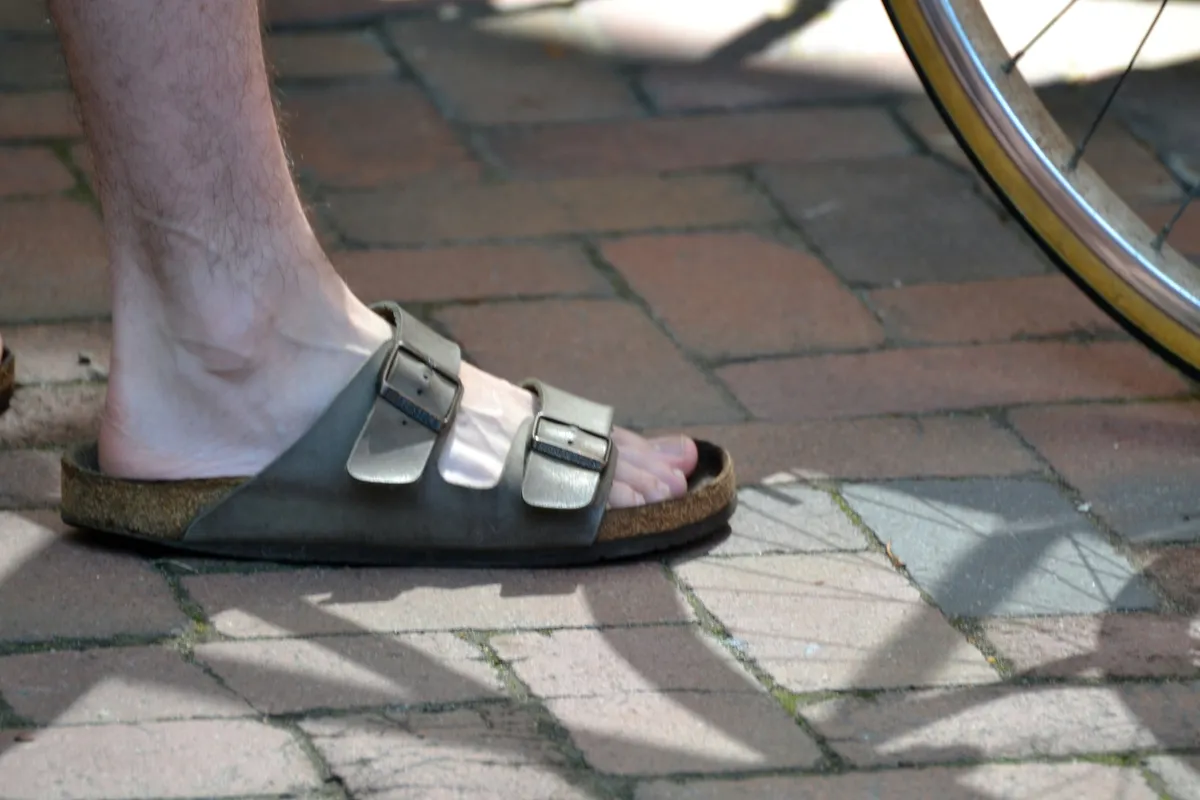
- Both buckles and straps show no wear after five months and 90 miles
- Two straps hold the foot considerably better than single-strap Birkenstock models
- Three weeks of genuine arch and forefoot soreness before they became comfortable
- European whole sizes only, and Regular vs Narrow width is poorly signposted
- Suede footbed absorbs rain and takes 24-48 hours to dry fully
- Rigid footbed and open heel make them unusable on gravel or uneven ground
- Developed a noticeable odour by week six without active management
- EVA outsole showed visible heel-edge wear after about 90 miles
The Birkenstock Arizona is sold on a promise that sounds like a warning: they will be uncomfortable at first, and then they will be the most comfortable thing you own. I wore a pair as my default warm-weather footwear for five months — about 340 recorded hours, including two travel weeks, a lot of standing in a kitchen, and roughly 90 miles of walking — specifically to find out whether that promise survives contact with a real summer.
It mostly does. But the break-in is genuinely worse than most reviews admit, the sizing system defeats people, and there are two situations in which these are the wrong shoe entirely.
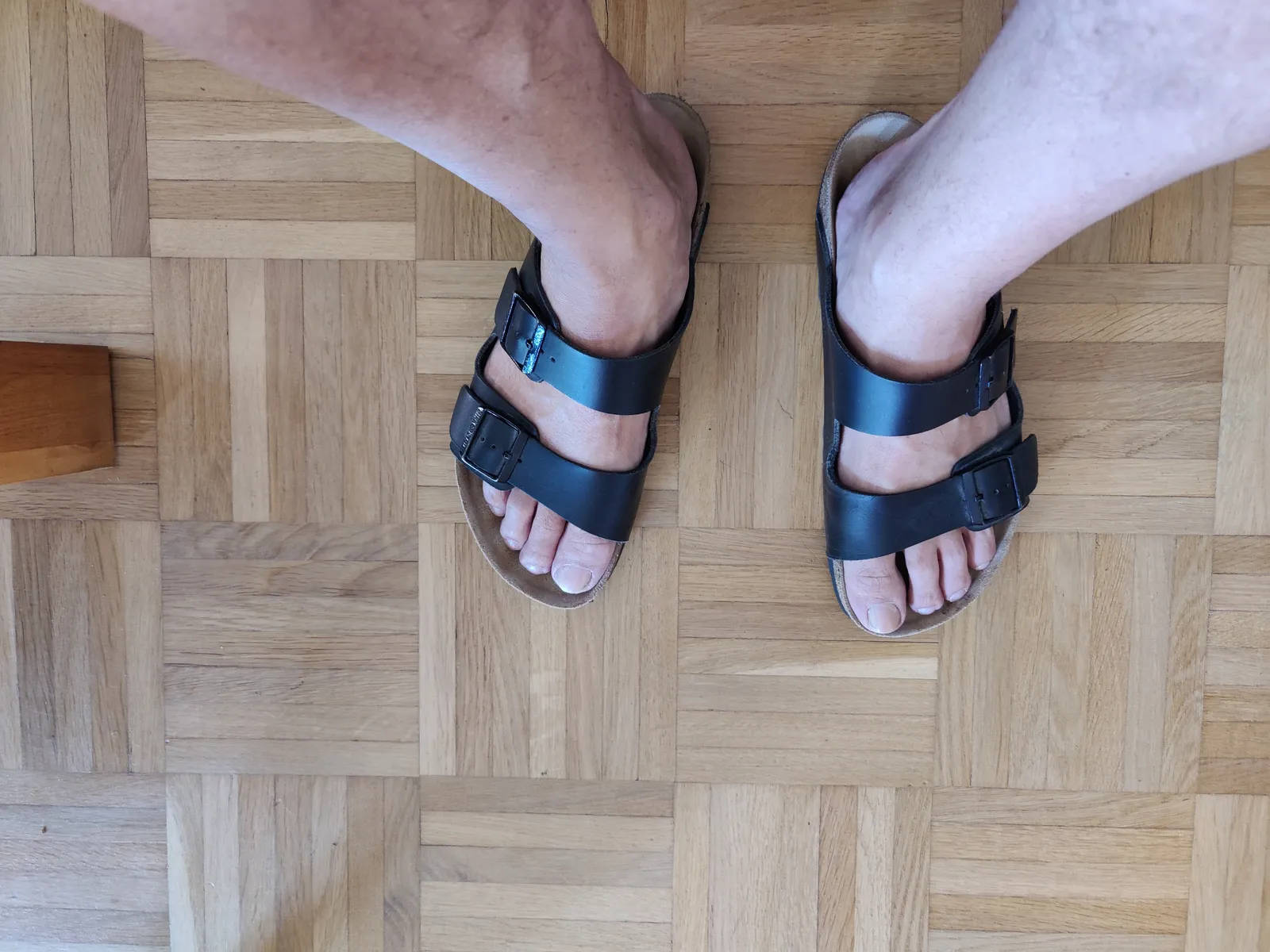
The footbed is the entire product
Everything distinctive about these sandals comes from the cork-and-latex footbed. It is not a flat sole with a squashy insert; it is a rigid, contoured platform with four deliberate features — a raised arch support, a deep heel cup, a transverse arch bump under the ball of the foot, and a raised lip at the toes.
New, that platform is close to unyielding. Standing in a fresh pair feels like standing on a shaped piece of wood, because functionally you are. The cork compresses under body heat and pressure over the first several weeks and gradually forms an impression of your specific foot. That process is the whole design, and it is why a broken-in pair feels custom and a new pair feels wrong.
Break-in, honestly measured
I logged how long I wore them each day and how they felt. Days 1 to 4, at about two hours a day, produced arch soreness that persisted for an hour after taking them off. Days 5 to 12 the soreness moved to a specific hot spot under the ball of my right foot where the transverse bump sits. Somewhere between day 18 and day 22 the sensation flipped: I stopped noticing the footbed and started noticing when I wasn't wearing them.
Total honest break-in for me was three weeks of gradually increasing wear. Anyone who tells you two days is either lucky in foot shape or not counting. The standard advice — an hour or two a day for the first fortnight, never a full day out of the box — is correct and I ignored it on day three and regretted it for the next 48 hours.
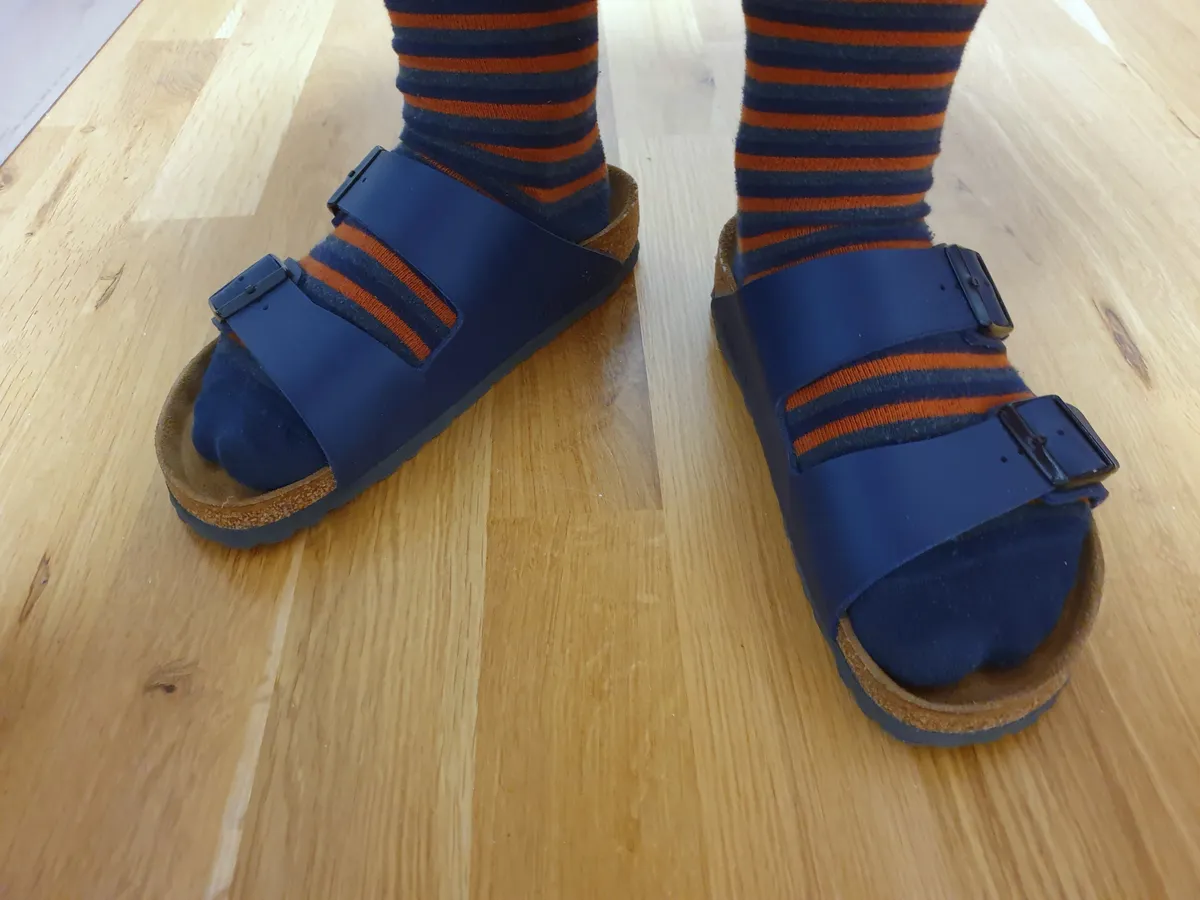
Sizing, and the mistake nearly everyone makes
Birkenstock sizes in European whole sizes only, with no half sizes and two width fittings — Regular and Narrow — that are not clearly labelled at most retailers. The Regular is genuinely wide. I take a US 9 and wear a 42 Regular; a friend with the same nominal size needed the Narrow and found the Regular sloppy enough that her foot slid forward on every step.
The fit test is specific: your heel should sit in the heel cup with about 3-5 mm of cork visible behind it, and your toes should have a clear gap before the raised toe lip. If your toes touch that lip, the sandal is too small, and no amount of break-in fixes it. If you can slide a finger flat under your arch while standing, it's too big.
The footbed markings on the underside tell you which width you have — a narrow footprint outline for Narrow, a wider one for Regular. Check that before buying secondhand, because it is the single most common reason people conclude Birkenstocks "don't work" for them.
What five months did to them
The suede lining over the footbed has darkened and compressed into a visible impression of my foot, which is expected and is the point. The cork sidewall has developed three hairline surface cracks — normal, and slowed considerably once I started applying cork sealer every couple of months as Birkenstock recommends.
The EVA outsole is the part that wears. Mine has visible flattening on the outer heel edge after roughly 90 miles, which is a faster wear rate than a decent walking shoe would show. The good news is that Birkenstock and independent cobblers will resole these for around $40-60, and the footbed — the expensive, personalised part — carries over. That changes the value calculation substantially versus a sandal that gets thrown away.
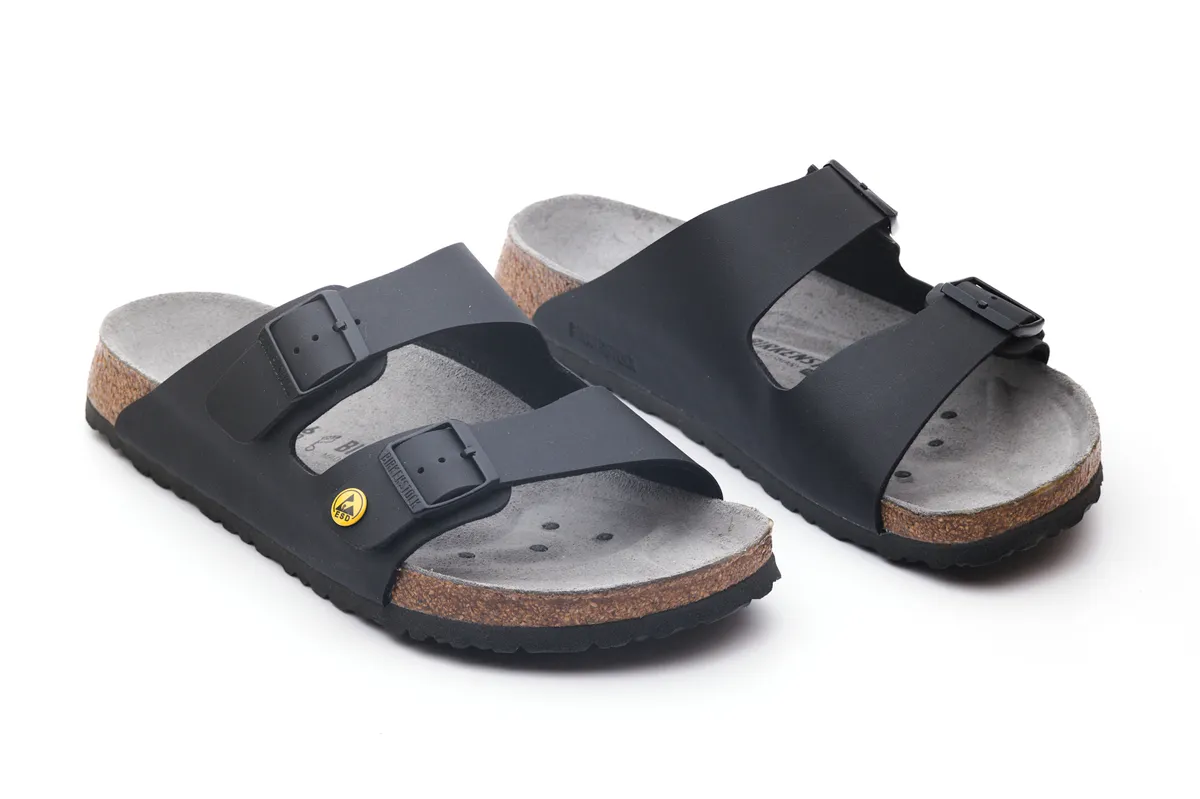
Both buckles still adjust cleanly and the straps show no cracking at the fold points. The metal pins on the buckles are the component I'd expect to fail eventually; they are replaceable for a few dollars.
Where they are genuinely excellent
Standing still. Five hours in a kitchen or at a market stall is where the footbed earns its reputation, and the difference against a flat sandal is not subtle — the load spreads across the whole foot instead of concentrating under the heel and ball. My feet stopped aching after long standing days somewhere in week four and haven't since.
Walking on hard flat surfaces is the second strength. City walking, airports, pavement — all fine, and I did an unplanned nine-mile day in them with no complaints beyond mild fatigue.
Where they are the wrong shoe
Wet. This is the one people learn the hard way. The suede-lined footbed absorbs water and takes 24-48 hours to dry fully, and the smooth cork gets slippery underfoot when damp. I got caught in rain in week seven and the sandals were unpleasantly clammy for two days. There is a rubber-lined "Birko-Flor" and an EVA all-plastic version specifically for wet use; the classic leather Arizona is not it.
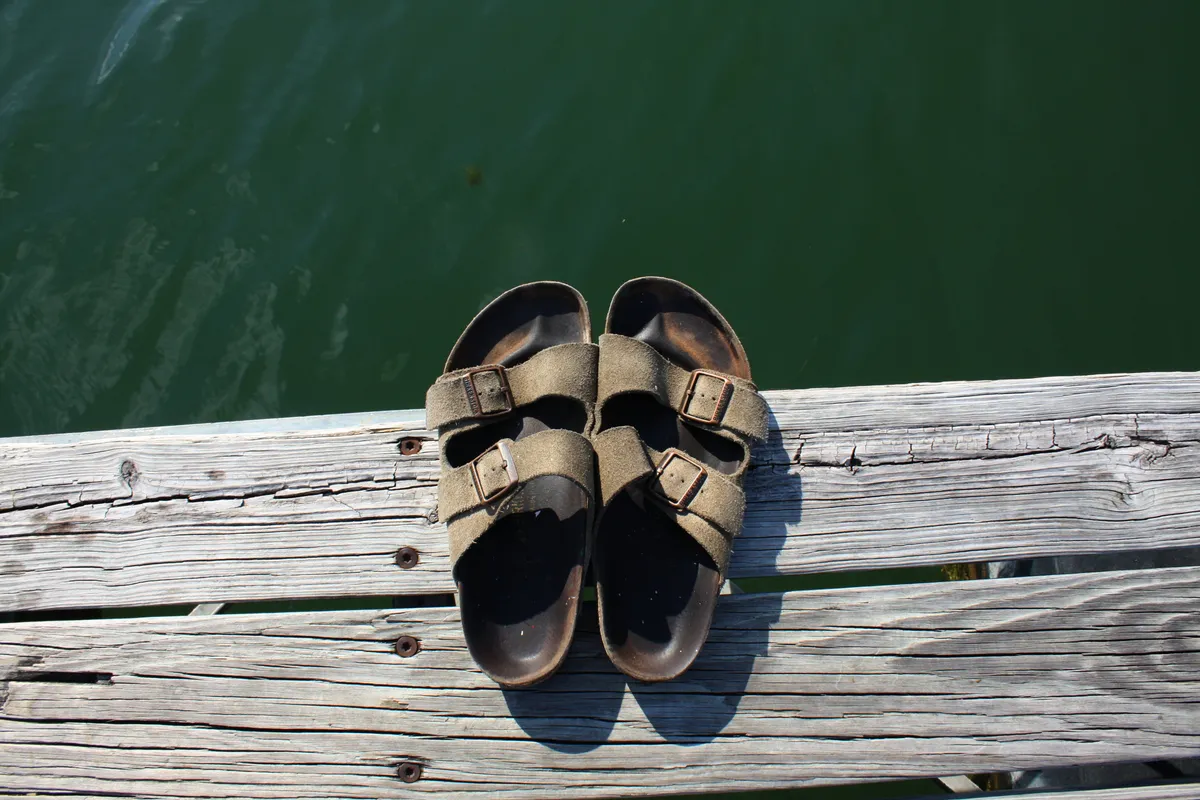
Uneven ground is the second failure. The rigid footbed doesn't flex with terrain, and the open heel means nothing holds your foot down. On a gravel trail my heel lifted off the footbed on every step and the sandal slapped. These are pavement and floor sandals, not hiking sandals, whatever the outdoorsy marketing photography suggests.
Third: they are loud. The heel slap on hard floors is real and I've been conscious of it in quiet offices and libraries.
Smell, and how to manage it
Worn barefoot daily, the suede footbed will develop an odour. Mine did, noticeably, around week six. What worked was rotating with a second pair of shoes so they dry fully between wears, brushing the footbed with a stiff dry brush weekly, and an occasional light scrub with a damp cloth and a little baking soda — never soaking them, which damages the cork.
What did not work was leaving them in the sun to air out; it dried the cork sidewall and I suspect contributed to the hairline cracks.
Two travel weeks, and what packing them is like
I took them on two trips during the test. As a travel shoe they have one significant advantage and one significant drawback. The advantage is that they cover an unusual range: presentable enough for a restaurant, structured enough for a full day of city walking, and they slip on and off in a security line in about two seconds. Over eleven days abroad I wore them for roughly 70% of my walking and left a bulkier pair of shoes in the suitcase most days.
The drawback is bulk. A pair of size 42 Arizonas takes up more suitcase volume than most flat shoes because the footbed is thick and rigid — they don't compress, don't nest, and don't fold. In a carry-on that mattered. My compromise on the second trip was to wear them on the plane and pack the lighter shoe instead, which also solved the security-line problem.
One practical travel note: airports are exactly the environment where the heel slap is loudest and where you're most likely to be walking on smooth polished floors for a mile at a stretch. Neither is a problem, but if you're self-conscious about noise, this is where you'll notice it.
Against the alternatives
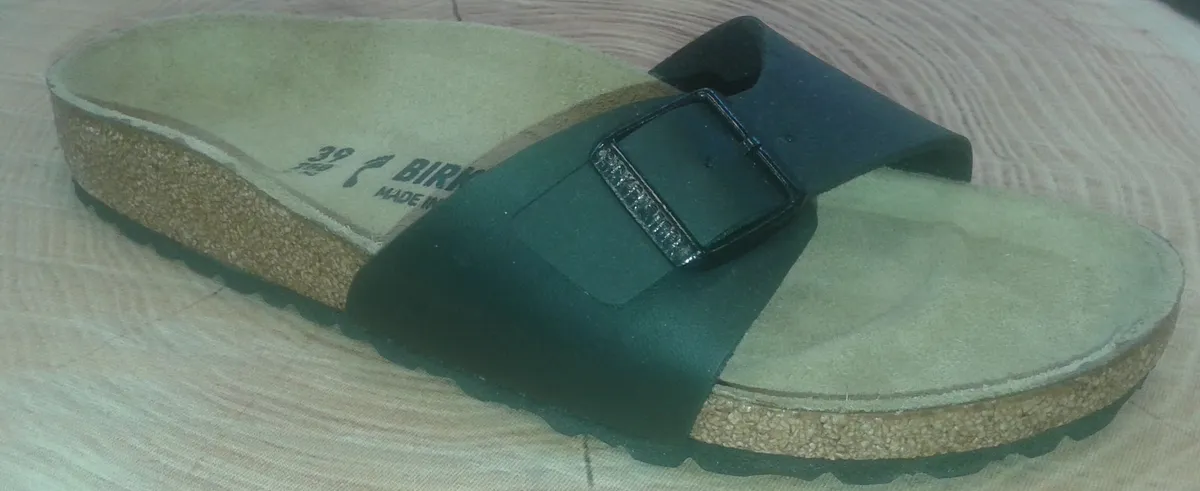
Against a $30 flat sandal, the Arizona costs three to four times as much and is a genuinely different product for standing and long walking. Against Birkenstock's own single-strap Madrid, the Arizona's two straps hold the foot considerably better and I'd pick it every time for anything beyond wearing around a house.
Against a modern cushioned recovery slide, the comparison is philosophical: the slide feels better immediately and provides no structure; the Arizona feels worse immediately and provides a lot. Five months in I prefer the Arizona for anything over about twenty minutes on my feet and the slide for the ten minutes after a run.
Who should buy this
Buy them if you spend long periods standing on hard floors, if you walk a lot on pavement in warm weather, and if you can commit to a genuine three-week break-in without giving up on day four. Buy them particularly if you intend to keep them for years, because resoling makes the cost-per-wear look very different from a disposable sandal.
Skip them if you need footwear that handles rain, if your walking involves trails or uneven ground, if you can't get to a shop to check Regular versus Narrow width, or if the idea of three weeks of foot soreness before a shoe becomes comfortable strikes you as an unreasonable thing to pay $110 for. That is a defensible position.
Verdict
After five months and roughly 340 hours, the Arizona has become the sandal I reach for without thinking, which is the outcome the design is aiming at. The footbed genuinely moulded, the standing comfort is real and measurable in how my feet feel at the end of a long day, and the resoling option makes the price defensible over a multi-year horizon. Against that: a three-week break-in that hurts, a sizing system that will mislead you, useless performance in wet or uneven conditions, and an odour problem that needs active management. Great shoes with unusually specific conditions attached.
Other products we tested

Ecobee Smart Thermostat Premium Review: Two Months of Real HVAC Testing
We installed the Ecobee Smart Thermostat Premium without a C-wire, tracked its temperature accuracy against a separate thermometer, and measured real energy savings over two months of daily HVAC use.
Bose SoundLink Flex Review: Six Weeks of Hiking, Kayaking, and Beach Days
Six weeks of camping, kayaking, and beach trips show the Bose SoundLink Flex's IP67 rating and PositionIQ orientation sensing are genuinely useful, with honest limits on bass and max volume.
Coros Pace 3 Review: Six Weeks Testing the GPS Watch That Barely Needs Charging
A dual-frequency GPS running watch that trades AMOLED shine for weeks of battery life at a fraction of the price of flagship rivals.